Introduction
When a commercial freezer goes down, the clock starts immediately. Spoiled inventory, potential health code violations, and lost revenue add up fast — and for business owners in Bryan, TX, the pressure to decide quickly is real. Rushing into the wrong choice, whether repair or replacement, can cost thousands more than necessary.
Repair feels cheaper upfront, but replacement often delivers better value over time. Knowing which path makes financial sense for your situation is the hard part.
This guide provides a clear framework: the warning signs that demand immediate attention, the conditions that favor repair, the scenarios where replacement is the smarter investment, and a practical decision-making process to help you choose without second-guessing.
Key Takeaways
- Commercial freezers last 10–15 years; age is your most reliable decision indicator
- Repair makes sense when the unit is under 7 years old and repair costs stay below 50% of replacement
- Replace when compressors or evaporator coils fail, the unit is 10+ years old, or breakdowns are recurring
- Rising energy bills and inconsistent temperatures are early red flags
- Get a professional assessment from a certified technician before committing to either option
Warning Signs Your Commercial Freezer Is in Trouble
Before you can decide between repair and replacement, you need to recognize what "trouble" actually looks like. Some warning signs point to simple, fixable issues. Others signal deeper systemic failure that will only get worse—and more expensive—over time.
Inconsistent or Rising Temperatures
A freezer that can't hold stable sub-zero temperatures is a direct food safety threat. The FDA Food Code requires frozen food to remain at 0°F or below, and temperature fluctuations often indicate failing thermostats, refrigerant leaks, or compressor issues that escalate quickly if ignored.
The downstream costs are severe:
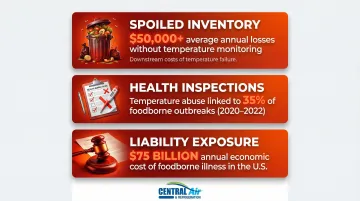
- Spoiled inventory: businesses without effective temperature monitoring face average annual losses exceeding $50,000
- Failed health inspections: temperature abuse contributed to over 35% of foodborne outbreaks in restaurants between 2020 and 2022
- Liability exposure: foodborne illness costs the U.S. economy roughly $75 billion annually
Any one of these outcomes can seriously damage your business. All three together can close it.
Unusual Noises and Excessive Frost Buildup
Loud humming, rattling, or clicking noises typically signal motor or compressor wear. Excessive frost buildup inside the unit points to defrost system failure or faulty door gaskets. These issues can often be repaired at reasonable cost, but they also signal broader mechanical decline—especially in older units.
Central Air & Refrigeration's technicians see these symptoms regularly across Bryan's restaurants, grocery stores, and medical facilities. The key is knowing which repairs extend a unit's life and which ones only postpone a full replacement by months.
Rising Energy Bills and Constant Cycling
A freezer that runs continuously or cycles on and off too frequently is working harder than it should—a sign of efficiency loss that shows up directly on your utility bill. ENERGY STAR certified commercial freezers are approximately 20% more efficient than standard models, meaning older or failing units can cost significantly more to operate.
Energy consumption comparison:
- Less efficient model: 949 kWh/year
- ENERGY STAR model: 602 kWh/year
- Savings: 36% reduction in annual energy use
For glass door freezers, upgrading to an ENERGY STAR model saves 900 kWh and over $110 annually—savings that accumulate to nearly $1,000 over the unit's lifetime.
Water Leaks and Visible Wear
Water pooling around the unit, damaged door seals, corroded interiors, or visible refrigerant oil stains all signal problems with seals, drains, or refrigerant lines. Some of these are straightforward repairs—a new gasket or drain line clearing. Others, like oil stains around the compressor, indicate compressor failure and a much bigger decision ahead.
When Repair Is the Right Call
For the right unit in the right condition, repair is the financially sound choice. The key is knowing which scenarios favor it.
The Unit Is Relatively New (Under 5–7 Years Old)
Newer units have most of their service life ahead of them, and parts are readily available. Minor or single-component failures on newer freezers almost always favor repair over replacement.
Additional considerations:
- Units still under manufacturer warranty can cut your out-of-pocket repair costs significantly
- A $600 repair on a 3-year-old unit buys you 7+ more years of service
- Current-generation parts are easier and cheaper to source than older, discontinued components
The Issue Is Isolated to a Single, Affordable Component
Some problems are repair-friendly by nature:
- Thermostat replacement
- Door gasket swap
- Fan motor fix
- Drain line clearing
Central Air & Refrigeration's technicians handle these issues routinely for Bryan businesses, often completing repairs the same day.
Not every repair is straightforward, though. Some failures shift the math toward replacement:
- Compressor failure
- Evaporator coil replacement
- Multi-system breakdowns
These typically shift the math toward replacement, especially in older units.
The 50% Rule Supports Repair
The widely-used 50% rule states: if the estimated repair cost is less than 50% of the price of a comparable new unit, repair is generally the financially sound choice.
Critical caveat: This calculation must factor in expected remaining lifespan. A $600 repair on a unit with 8 years of life left is very different from the same repair on a 12-year-old freezer nearing the end of its expected service window.
When Downtime Makes Immediate Replacement Unrealistic
Replacement takes time—sourcing a unit, scheduling installation, adjusting operations. In some cases, a targeted repair to extend the unit's life 6–12 months is the right bridge decision while you plan a replacement budget.
Central Air & Refrigeration's 24/7 emergency response at (979) 324-6791 helps Bryan businesses get back online fast, buying time to make a thoughtful replacement decision rather than a rushed one.
When Replacement Makes More Sense
Sometimes the honest answer is that keeping the old unit running costs more in the long run than investing in a new one.
The Unit Is 10+ Years Old and Breaking Down Frequently
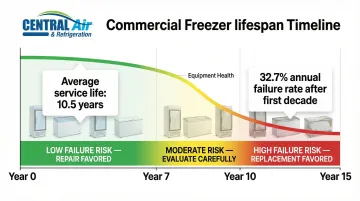
Commercial freezers typically last 10–15 years. Units in this age range that require repeated repairs are in diminishing-returns territory—each fix buys less time and confidence.
The numbers tell a clear story:
- Walk-in refrigeration systems average 10.5 years of service life
- Self-contained units show a 32.7% annual failure rate over their first decade
- After 10 years, repair frequency accelerates as multiple components near end-of-life simultaneously
Major Component Failure: Compressor or Evaporator Coil
Compressor or evaporator coil failure often tips the scales toward replacement. These are among the most expensive components to replace, and their failure in an older unit typically signals that other components are close behind.
Compressor replacement costs:
- Total cost (parts + labor): $600–$1,350+
- Compressor part alone: $100–$650
- Includes: Refrigerant recovery and recharge
When a single repair approaches or exceeds 50% of a new unit's cost and the unit is already aging, replacement wins. Outdated refrigerant adds another layer to that math.
Outdated Refrigerant and Parts Availability
Older commercial freezers may run on refrigerants being phased out, such as R-22. As of January 1, 2020, the EPA banned production and import of R-22—only recovered, recycled, or reclaimed supplies remain available.
Here's where that leaves operators today:
- R-22: Limited to reclaimed stock; prices rising as supply shrinks
- R-404A alternative: $6–$12 per pound in 2025, with some states requiring reclaimed refrigerant for existing equipment
- No drop-in replacements: Converting a system requires component changes and EPA approval, adding to repair costs
For units still running on R-22, the cost to keep them compliant often exceeds the cost of replacement outright.
Energy Inefficiency Is Costing the Business Monthly
Modern commercial freezers are far more energy-efficient than units from 10+ years ago. The monthly savings in utility costs from a new unit can offset the replacement investment over time.
Energy savings example:
- Old "Less Efficient" model: 949 kWh/year
- New "Best Available" model: 394 kWh/year
- Annual savings: 555 kWh
- Lifetime cost savings: $480
With Texas commercial electricity rates averaging 9.79 cents per kWh, these savings add up—especially in Bryan's hot climate where refrigeration equipment works harder year-round. Energy-efficient equipment may also qualify for utility rebates or tax incentives, further improving ROI.
Health and Safety Compliance Risk
A freezer unable to consistently hold required temperatures puts your business at risk on multiple fronts:
- Health code violations during routine inspections
- Failed audits that trigger fines or temporary closures
- Foodborne illness liability — a risk no repair bill can offset
For restaurants, grocery stores, and medical facilities in Bryan, temperature instability alone justifies replacement. No patch fixes the underlying risk.
How to Make the Final Decision: A Practical Framework
When you're staring down a repair quote, the decision doesn't have to be a gut call. Run through these two checks before committing either way.
Apply the Age + Cost + Frequency Test
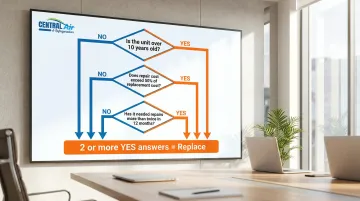
Use this simple three-part test:
- Is the unit over 10 years old?
- Does the repair cost exceed 50% of replacement cost?
- Has the unit needed repairs more than twice in the past 12 months?
If the answer to two or more of these is yes, replacement is likely the right call.
Central Air & Refrigeration provides honest assessments to help Bryan, TX businesses work through exactly this decision—no upselling, no pressure.
Factor in the Hidden Costs of Keeping a Failing Unit
The Age + Cost + Frequency test tells you about the unit. This next check tells you about the true cost. Don't just compare the repair quote to the replacement price tag—include:
- Lost inventory from temperature failures
- Downtime costs and lost sales
- Emergency service call fees
- Rising monthly energy bills
- Risk of health code violations
These hidden costs often make the "cheaper" repair option more expensive in total. A $700 repair might look better than a $3,000 replacement—until you add $500 in spoiled inventory, $200 in emergency service fees, and $50/month in excess energy costs. Run those numbers, and replacement often pays for itself faster than expected.
How Central Air & Refrigeration Can Help
Central Air & Refrigeration has spent over 10 years serving restaurants, grocery stores, medical facilities, and businesses throughout Bryan, TX. The team provides straightforward assessments that help business owners understand their equipment's actual condition and the real cost-benefit of repair versus replacement—before spending a dollar on either.
Key differentiators:
- 24/7 emergency response for freezer failures—call (979) 324-6791 anytime
- Certified technicians trained in the latest refrigeration technologies
- Transparent pricing with no hidden fees—you get a clear estimate before work begins
- No upselling—recommendations are based on what makes financial sense for your operation, not what generates the highest service ticket
Whether the diagnosis points to a straightforward repair or a full replacement, you'll get a clear explanation of why—and a fair price either way.
Contact Central Air & Refrigeration today at (979) 324-6791 for a professional assessment.
Frequently Asked Questions
Should I repair or replace a commercial freezer?
The right choice depends on the unit's age, repair cost, and breakdown frequency. If repair costs exceed 50% of a new unit's price or the freezer is over 10 years old with recurring issues, replacement is usually the better investment.
What is the life expectancy of a commercial freezer?
Most commercial freezers last 10–15 years with proper maintenance. Well-maintained units can reach the higher end of that range, while heavily used or neglected units may show significant decline earlier.
How much does it cost to repair a commercial freezer?
Costs vary widely by component—minor fixes like gasket or thermostat replacements are affordable, while compressor or evaporator coil repairs can run $600–$1,350 or more. Getting a technician's assessment upfront helps you weigh repair cost against replacement value.
What is the 50% rule for commercial freezer repair?
The 50% rule is a repair-vs-replacement benchmark: if the repair cost exceeds 50% of a comparable new unit's price, replacement is generally the more cost-effective long-term decision.
How do I know if my commercial freezer compressor is failing?
Key signs include the unit running constantly but not holding temperature, loud clicking or humming sounds, and inconsistent temperatures inside the cabinet. Because compressor repairs rank among the costliest fixes, a failing compressor is a strong trigger to evaluate full replacement.
Can regular maintenance help avoid early replacement?
Yes. Preventive maintenance—including coil cleaning, gasket inspection, refrigerant checks, and drain clearing—significantly extends equipment lifespan and reduces the likelihood of major breakdowns that force premature replacement.