

This guide cuts through the confusion. You'll learn the warning signs that point toward repair, the red flags that mean replacement, and a simple framework to make the decision confidently. No guesswork—just clear criteria based on your unit's age, repair history, and the unique demands of Texas heat.
TLDR: Quick Answer Before You Read On
- Repair if your AC is under 10 years old and the issue is isolated — think capacitor, thermostat, or drain line
- Repair if you haven't had repeated breakdowns this season and costs are well under 50% of a replacement
- Replace if your unit is 12–15+ years old, runs on R-22 refrigerant, or keeps breaking down
- Replace if repair costs exceed 50% of a new unit's price — you're throwing money at a losing battle
- Texas AC units wear out faster than the national average due to longer, more intense cooling seasons
- Get a professional diagnostic before committing to either path
Why Texas Heat Hits Your AC Harder Than Most States
Bryan summers aren't just hot—they're long, humid, and relentless. The AC season here runs 8–9 months versus 4–5 months in northern states, meaning your unit logs far more operating hours per year.
The numbers tell the story:
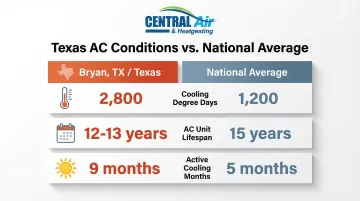
- Cooling Degree Days: Brazos County accumulates approximately 2,800 cooling degree days annually, compared to roughly 1,200 in northern states
- Lifespan impact: Texas AC units typically last 12–13 years versus the 15-year national average
- Operational months: 9 months of active cooling versus 5 months elsewhere
What Causes the Accelerated Wear
High ambient temperatures stress compressors directly. A 10°F rise in outdoor temperature increases compressor discharge temperature by about 5%, accelerating oil breakdown and mechanical fatigue.
Bryan's humidity compounds that stress. Moisture accumulation on condenser coils promotes corrosion that reduces heat-transfer efficiency by 15–20% over time, forcing longer run cycles to achieve the same cooling effect.
Your AC also works double duty here: cooling and dehumidifying. That combined load strains an already-stressed system, shortening component life across the board.
Signs Your AC Needs a Repair (Not a Replacement)
Isolated Mechanical Issues with Fixable Components
Certain problems are straightforward and inexpensive to fix. Failed capacitors, worn contactors, clogged condensate drain lines, and faulty thermostats are common failure points—but they don't indicate the whole system is dying. These are normal wear items.
Common repair costs:
| Component | Cost Range |
|---|---|
| Capacitor | $100–$400 |
| Contactor/Relays | $75–$290 |
| Condensate Drain Clearing | $75–$250 |
| Thermostat Replacement | $100–$300 |
| Blower Motor | $200–$700 |
If the compressor, evaporator coil, and condenser coil are still in good shape, spending money on a minor repair makes sense—especially for units under 10 years old.
Unusual Noises or Strange Smells
Different sounds point to different problems, most of which are repairable:
- Rattling/banging = loose or broken component (usually repairable)
- Screeching = fan belt or motor bearing (repairable)
- Gurgling = refrigerant line issue (requires further assessment)
- Musty odors = mold in drain pan or ducts (typically fixable without full replacement)
Catching these early—before a $150 capacitor swap becomes a $1,200 motor replacement—is where the real savings happen.
Weak Airflow or Inconsistent Cooling
The most common culprits are usually fixable:
- Dirty or clogged air filter
- Blocked return vents
- Failing blower motor
These aren't signs of total system failure—they're signs of deferred maintenance or a single component needing attention. If your system is otherwise cooling efficiently and energy bills haven't spiked, inconsistent airflow typically means repair, not replacement.
Moisture or Minor Refrigerant Issues
Water and refrigerant issues sound alarming, but they're often minor. A clogged condensate drain causing water pooling near the indoor unit is a common, inexpensive fix. A small refrigerant recharge often solves cooling problems if the system is otherwise in good condition.
Caution: If refrigerant leaks recur or your system uses R-22 (see replacement section below), repair costs can quickly outpace the value of keeping the unit running.
Clear Signs It's Time to Replace Your AC Unit
Your Unit Is 12–15 Years Old (or Older)
In Texas, AC units typically reach end-of-life between 12–15 years. If your unit falls in this range and requires a costly repair, you're paying to extend the life of a system already near retirement, which rarely pays off.
Older systems also use less efficient refrigerants and lower SEER ratings, meaning you overpay on energy bills every month you keep running it.
Your System Uses R-22 (Freon) Refrigerant
R-22 was phased out federally effective January 1, 2020. Servicing R-22 systems now relies entirely on recovered, recycled, or reclaimed supplies, and prices have surged, often reaching $60–$250 per pound.
If a tech tells you your system needs R-22, that alone can make repair costs prohibitive. Any repair is a band-aid since the refrigerant problem will recur.
Frequent Breakdowns and Escalating Repair History
If you've called for service two or more times in a single season, or your cumulative repair bills over the past two years are adding up, the system is telling you something. Compounding failures signal system-wide deterioration, not isolated problems:
- Capacitor fails, then the blower motor, then the coil
- Repair costs accelerate while system efficiency drops
- Each fix buys less time than the one before it
Your Home Can't Stay Comfortable Even When the AC Runs Constantly
If your AC runs all day and your Bryan home still hovers above 78–80°F, the system has lost the capacity to meet demand. High indoor humidity, uneven cooling across rooms, and a thermostat that never reaches setpoint are all signs of this.
Age-related efficiency loss, refrigerant depletion, or degraded components can all cause this pattern.
An AC struggling to maintain setpoint in Texas heat is a health and safety concern—especially during peak summer months when temperatures regularly exceed 100°F.
The Repair vs. Replace Decision Framework
The $5,000 Rule
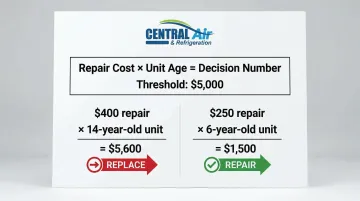
Multiply the repair cost by the unit's age. If the result exceeds $5,000, replacement is generally the smarter financial move.
Examples:
- $400 repair on a 14-year-old unit = $5,600 → Replace
- $250 repair on a 6-year-old unit = $1,500 → Repair
It's a quick calculation, not a guarantee—but it cuts through indecision fast.
The 50% Rule
If the cost of repair exceeds 50% of what a new comparable unit would cost, replacement wins on a long-term value basis—especially given energy savings from higher-SEER modern systems.
The Energy Savings Case for Replacement
Newer high-SEER units can cut your monthly cooling costs substantially. The jump from SEER 10 to SEER 16 alone yields roughly 38% in annual cooling energy savings—and the savings scale up from there:
Energy savings by upgrade scenario:
| Upgrade Path | Annual Cooling Energy Savings |
|---|---|
| SEER 10 → SEER 16 | ~38% |
| SEER 13 → SEER 16 | ~20–22% |
| SEER 13 → SEER 18 | ~30% |

Additional Factors to Consider
- How many more years you plan to stay in the home — replacement makes more sense if you're staying long-term
- Timing relative to summer season — replacing before peak demand avoids emergency pricing and scheduling delays
- Available rebates and financing — federal tax credits and local utility rebates can offset replacement costs significantly
Two programs worth knowing about before you commit:
- The Inflation Reduction Act offers a 30% federal tax credit up to $600 for qualifying central AC installations.
- Bryan Texas Utilities' SmartHOME rebate program returns 10–25% back (up to $1,500) on ENERGY STAR® rated systems.
What to Do Before (and When) You Call an HVAC Tech in Bryan, TX
Check These Items Before Calling
You can sometimes resolve simple problems or gather useful information by checking:
- Thermostat is set correctly and has fresh batteries
- Circuit breaker hasn't tripped
- Air filter—replace if it's been more than 30–60 days
- Outdoor condenser unit—clear any debris blocking airflow
Questions to Ask the Technician
When the tech arrives, get answers that give you the full picture:
- What is the exact cause of the failure?
- How old are the key components (compressor, coil)?
- What is the estimated remaining lifespan of the current system?
- Are there any manufacturer warranties still in effect?
- What would a comparable replacement system cost?
These questions give you the information needed to make a confident repair-or-replace decision before any work begins.
When You're Ready to Call
Central Air & Refrigeration has served Bryan homeowners for 10+ years, and their certified technicians know firsthand how Texas heat pushes AC systems to their limits. They offer transparent pricing and honest diagnostics—so you get a clear answer, not an upsell. Reach them at (979) 324-6791 for emergency service or to schedule an inspection.
Frequently Asked Questions
Frequently Asked Questions
How long should AC units last in Texas?
Texas AC units typically last 12–13 years due to the state's long, hot cooling seasons and high humidity, shorter than the 15-year national average. Regular maintenance helps, but the relentless summer workload accelerates wear on every major component.
What is the rule for HVAC repair vs replace?
The $5,000 Rule multiplies repair cost by unit age—if the result exceeds $5,000, replace. The 50% Rule states that if repair cost exceeds half the cost of a new unit, replacement is usually smarter financially, especially when factoring in energy savings from modern systems.
How do I know when an AC unit needs to be replaced?
Watch for these warning signs:
- Unit is 12–15+ years old or uses R-22 refrigerant
- Multiple repairs needed within a single season
- Home stays above 78–80°F even with the AC running constantly
That last point is a strong indicator the system has lost capacity and can no longer handle Texas heat loads.
Is it cheaper to repair or replace an AC unit?
Repairs cost less upfront, but replacement typically saves more over time through lower energy bills and fewer service calls. Use the $5,000 Rule and 50% Rule alongside your unit's age and repair history to make the call.
What is the average cost to replace an AC system?
Current Texas replacement costs range from $5,800–$7,500 for a 2-ton system to $9,000–$12,000 for a 4-ton system. Costs vary by system size, SEER rating, and installation complexity. Federal tax credits and local utility rebates can offset a portion of these costs.
How much is a new air conditioner for a 2000 sq ft house?
A 2,000 sq ft home in Texas typically requires a 3–4 ton unit. Budget $7,000–$9,000 for a 3-ton system or $9,000–$12,000 for a 4-ton system, including equipment and installation — proper sizing matters more in Texas than most other states.