Introduction
Picture this: The first cold snap arrives in Bryan, TX, and your furnace kicks on. A minute later, it shuts off. Then it starts again. Then stops. This maddening on-off pattern isn't just annoying—it's a red flag that something is wrong with your heating system, and ignoring it could leave you facing a costly breakdown in the dead of winter.
That on-off behavior has a name: furnace short cycling, and it's one of the most common heating complaints technicians hear. The causes range from simple fixes like a clogged air filter to serious safety hazards like a failing heat exchanger. Catching it early can mean the difference between a $150 filter swap and a $1,200 emergency repair call.
This guide covers everything you need to know:
- What short cycling is and why it happens
- Which causes you can fix yourself
- When to call a professional
- How to decide between repair and replacement
- Steps to prevent it from recurring
Key Takeaways
- Short cycling means your furnace turns on and off too quickly, before completing a full heating cycle
- Common culprits: dirty filter, thermostat issues, oversized furnace, blocked vents, or a faulty flame sensor
- Several fixes are DIY-friendly (filter swap, thermostat check, clearing vents); others require a certified technician
- Ignoring it drives up energy bills, speeds up wear, and risks carbon monoxide exposure
- Best long-term defense: annual furnace maintenance before heating season begins
What Is Furnace Short Cycling?
Short cycling is a malfunction where your furnace turns on, runs briefly (typically fewer than 7 minutes), shuts off before reaching the set temperature, and restarts almost immediately. Rather than completing a full heating cycle, it loops through rapid start-stop sequences that wear down components and leave your home unevenly heated.
What a Normal Cycle Looks Like:
A healthy residential gas furnace cycles 3 to 8 times per hour, with each heating cycle lasting 10 to 20 minutes. If your furnace shuts off in less than 5 minutes or cycles more frequently than 8 times an hour, it is short cycling.
On very cold nights, more frequent cycles are normal — your furnace is working harder to offset heat loss. But if it shuts off every few minutes even when the house is still cold, or the pattern persists regardless of outdoor temperature, something is causing it to cut out early. The sections below cover the most common culprits.
Common Causes of Furnace Short Cycling
Most short cycling traces back to a handful of well-known root causes. Pinpointing the right one before attempting any fix is what determines whether the repair actually holds.
Clogged or Dirty Air Filter
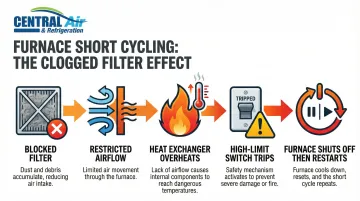
A blocked filter starves the furnace of airflow, causes internal temperatures to spike, and trips the high-limit switch as a safety shutoff—leading to the on-off pattern. This is the single most common and most easily fixed cause.
- Restricted airflow prevents heat from moving away from the heat exchanger
- Internal temperature rises rapidly
- High-limit switch detects dangerous overheating and cuts fuel supply
- Blower continues running to cool the unit
- Once cooled, furnace restarts and the cycle repeats
Thermostat Problems
Two sub-causes here: a malfunctioning thermostat sending erratic signals, or a thermostat positioned near heat sources—vents, direct sunlight, or nearby appliances—that tricks it into misreading the room temperature and cutting the cycle short.
Symptoms you'll notice:
- Furnace shuts off even though the house feels cold
- Temperature swings between rooms
- System cycles on and off within minutes
- Thermostat reading doesn't match actual room temperature
Oversized Furnace
An oversized unit heats the home too quickly, satisfies the thermostat before a proper cycle completes, and restarts repeatedly. Homes that have had insulation upgrades since the original furnace installation are particularly prone to this—the system was sized for an older, less efficient envelope.
Research shows that 33-48% of residential HVAC systems are oversized compared to proper sizing calculations. More heating capacity doesn't mean more comfort—it means more wear, more cycling, and higher bills.
Faulty or Dirty Flame Sensor
The flame sensor confirms a burner is lit. A dirty or corroded sensor fails to detect the flame and shuts off the gas supply within 4 seconds of startup, mimicking short cycling.
- Sensor rod becomes coated with oxidation or carbon buildup
- Cannot send proper electrical signal to control board
- Control board assumes no fire exists and shuts gas valve
- System attempts restart immediately
Faulty High-Limit Switch or Overheating
The high-limit switch acts as a safety guard against overheating. If it is worn or malfunctioning, it trips at normal operating temperatures rather than dangerously high ones, causing premature shutoffs.
Repeated tripping without fixing the root cause (usually airflow restriction) can cause the switch itself to fail permanently.
Cracked Heat Exchanger or Blocked Flue
A cracked heat exchanger and a blocked flue are the most serious causes on this list. A cracked exchanger causes overheating and short cycling while posing a carbon monoxide risk. A blocked flue triggers the flue limit switch as a protective response.
- Cracked heat exchanger disrupts combustion process
- Allows deadly carbon monoxide to leak into indoor air
- Blocked flue prevents proper venting of combustion gases
- Pressure switch detects problem and shuts system down
Both require professional diagnosis immediately and should not be left until after winter.
How to Fix a Short-Cycling Furnace Before Winter
Start by isolating the actual cause before touching anything else — fixing the wrong thing first wastes time and money. Work through these steps from most accessible to most complex.
Step 1: Replace or Inspect the Air Filter
Where to find it: Most filters are located in the return air duct or blower compartment. Check your furnace manual if you're unsure.
What a clogged filter looks like:
- Visible dust and debris coating the surface
- Filter appears dark gray or brown instead of white
- Cannot see light through the filter material
- Filter sags or appears warped
How often to change: Check filters monthly and replace at least every 3 months. In Bryan, TX homes where furnaces sit dormant through hot summers, check the filter before the first cold snap—a filter that collected dust all summer can cause immediate short cycling when heat is turned on.
Choosing the right replacement: Use the MERV rating recommended in your furnace manual, typically MERV 8-13 for residential systems. Higher MERV ratings improve air quality but increase airflow resistance.
Step 2: Check the Thermostat
Battery check: Replace batteries even if they seem fine. Weak batteries cause erratic signals.
Recalibration: Most digital thermostats have a recalibration or reset function in the settings menu. Consult your thermostat manual for specific steps.
Placement verification: Check whether the thermostat sits near a supply vent, gets direct sunlight during the day, or is close to the kitchen or other heat sources. Any of these will cause it to misread the room temperature and trigger false shutoffs. Relocating the thermostat fixes this — but since it requires running new wire, leave it to a professional.
Step 3: Clear Vents and Check for Airflow Obstructions
Inside the home:
- Walk through each room and check supply registers
- Remove furniture, curtains, or debris blocking vents
- Open any dampers that were closed
- Inspect return air vents for blockages
Outside the home:
- Locate the exhaust flue pipe (typically a white PVC pipe on newer furnaces)
- Check for bird nests, leaves, or debris
- In winter, check for ice blockage
- Clear any obstructions carefully
A blocked flue activates the flue limit switch and shuts the system down immediately.
Step 4: Clean or Replace the Flame Sensor
A dirty flame sensor follows a predictable pattern: the system starts normally, the burner ignites briefly, then the flame cuts out within 3–5 seconds while the blower keeps running before the system attempts to restart. If that matches what you're seeing, clean the sensor first.
Signs to confirm it's the sensor:
- Burner ignites but shuts off within 3–5 seconds
- Blower continues running after flame cuts out
- System cycles through repeated restart attempts
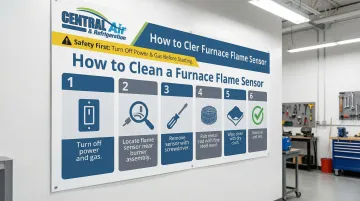
To clean it:
- Turn off power and gas to the furnace
- Locate the flame sensor — a thin metal rod near the burner assembly
- Remove the sensor (typically one screw)
- Gently rub the metal rod with fine steel wool or emery cloth
- Wipe clean with a dry cloth
- Reinstall and test
If cleaning doesn't restore function, the sensor itself needs replacing — a quick job for a technician.
Step 5: Call a Professional for Heat Exchanger, Limit Switch, or Sizing Issues
Cracked heat exchangers, a chronically tripping limit switch, and an oversized furnace are not DIY fixes. These require proper diagnostics, specialized tools, and in some cases full replacement.
If your furnace is still short cycling after working through Steps 1–4, one of these deeper issues is likely the culprit. Central Air & Refrigeration has diagnosed and repaired furnace problems in Bryan, TX homes for over a decade. Call (979) 324-6791 to schedule a diagnostic — they offer same-day and emergency service Monday through Friday.
When to Fix vs. Replace Your Furnace
Knowing whether to repair or replace comes down to one practical question: is the short cycling caused by a single fixable component, or is the system itself the problem?
When Repair Is the Right Call
Repair makes sense when:
- Furnace is under 10-12 years old
- Cause is a single identifiable component (flame sensor, limit switch, thermostat)
- Repair cost is under $500 — a small fraction of a new unit
- The system is otherwise running reliably and efficiently
When Replacement Makes More Financial Sense
Replace instead of repair when:
- Furnace is 15+ years old with multiple recurring issues
- Heat exchanger is cracked — a safety concern that typically can't be patched
- Short cycling is caused by an oversized unit that no repair can correct
- Cumulative repair costs are closing in on replacement cost
Two quick rules of thumb help with the math:
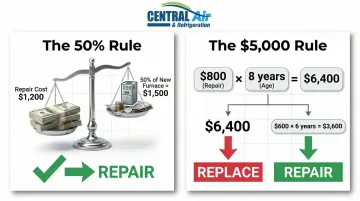
- The 50% Rule — If the repair cost exceeds half the price of a new furnace, replace it.
- The $5,000 Rule — Multiply the repair cost by the furnace's age in years. If the result tops $5,000, replacement wins. (Example: $400 repair × 15 years = $6,000 → replace the unit.)
Beyond the repair math, efficiency gains are worth factoring in. Replacing an older 80% AFUE furnace with a modern 95% AFUE condensing unit typically cuts heating costs by roughly 19%, with most homeowners seeing payback within 4 to 6 years through lower monthly bills.
How to Prevent Short Cycling from Happening Again
The majority of short cycling causes—dirty filters, blocked vents, thermostat drift—are preventable through a consistent maintenance routine. This protects both the equipment and your household budget heading into winter.
Key preventive habits:
- Replace air filters on schedule: Check monthly, replace every 3 months minimum (more frequently if you have pets or high dust)
- Keep vents unobstructed: Ensure furniture, curtains, and storage items don't block supply or return vents
- Check outdoor exhaust flue: Inspect at the start of each heating season for nests, debris, or ice
An annual tune-up is the most reliable way to catch developing issues — a failing flame sensor, limit switch wear, heat exchanger stress — before they cause a mid-winter breakdown.
Central Air & Refrigeration's preventive maintenance service covers:
- Detailed system inspection and combustion analysis
- Air filter replacement and blower/motor inspection
- Lubrication of moving parts
- Thermostat calibration
- Safety checks including carbon monoxide testing
Schedule your fall tune-up by calling (979) 324-6791 or emailing centralaaservice@gmail.com.
This is especially worthwhile for Bryan homeowners who run their furnace infrequently. A pre-season check confirms the system is safe during hard freezes and catches problems that developed while it sat idle all summer.
Conclusion
Short cycling is almost always traceable to one of a handful of known causes, and catching and addressing it before winter spares homeowners from breakdowns, inflated energy bills, and potentially unsafe operating conditions. While many common fixes are accessible to a handy homeowner—filter replacement, thermostat checks, clearing vents—anything involving the heat exchanger, limit switch, or system sizing requires a trained technician.
Acting before winter is typically far cheaper than emergency repairs during it. If your furnace is cycling too frequently, work through the troubleshooting steps above, and when the problem goes beyond DIY fixes, reach out to a certified HVAC technician. Central Air & Refrigeration has been serving homeowners and businesses in Bryan, TX for over a decade — if your furnace needs a professional eye before temperatures drop, they're a reliable local option to call.
Frequently Asked Questions
Frequently Asked Questions
How much does it cost to fix a short cycling furnace?
Costs range from $1-$35 for a filter replacement to $100-$300 for flame sensor service, $150-$300 for a high-limit switch, and $1,500-$3,500 for heat exchanger replacement. Contact a certified technician for an accurate diagnosis and estimate.
How often should a furnace kick on and off?
A properly functioning furnace should cycle 3 to 8 times per hour, with each cycle lasting 10 to 20 minutes. If your furnace runs for less than 5 minutes at a time or cycles more than 8 times per hour, it is short cycling and needs attention.
What is the most common cause of short cycling?
A dirty or clogged air filter is the most common and easily fixed cause of short cycling. An oversized furnace is the most common structural cause that requires professional attention and may not be repairable without replacement.
Can a bad thermostat cause short cycling of a furnace?
Yes. A faulty thermostat — or one placed near heat sources like vents, sunlight, or appliances — sends incorrect temperature signals that cut cycles short. Replacing the batteries, recalibrating, or relocating the thermostat often resolves it.
Can a dirty flame sensor cause short cycling?
Yes, a coated or corroded flame sensor fails to detect the burner flame and shuts down the gas supply within 4 seconds of startup. This repeated start-stop pattern is a classic sign of short cycling. Cleaning the sensor with fine steel wool often restores normal function.
What are the symptoms of a bad gas valve on a furnace?
Key symptoms include failure to ignite, weak or irregular burner flames, and shutdown shortly after startup. Gas valve issues require a licensed HVAC technician — don't attempt diagnosis or repair without professional equipment.