

Introduction
When your air conditioner fails in Bryan, TX (or when you're planning a major upgrade), the choice between a mini split and central AC isn't one to make lightly. Unlike most of the country, where summer is a brief inconvenience, Texas homeowners face an 8-month cooling season with temperatures that regularly push into the mid-90s.
The system you choose will directly affect your monthly energy bills, the disruption of installation, your home's resale value, and how well your family sleeps through those brutal August nights.
The right answer depends on factors specific to your home: whether you have existing ductwork, how your rooms are laid out, and what matters most to you—upfront cost, long-term savings, or room-by-room control.
Key Takeaways
- Mini splits are ductless systems with individual indoor units, best for homes without ductwork or rooms needing targeted comfort
- Central AC uses a single system and ductwork to cool your whole home, making it a strong fit for larger houses with existing ducts
- Mini splits cost more upfront per zone but pay back through lower energy bills during Texas's long cooling season
- Your existing ductwork condition is the single biggest factor determining which system makes financial sense
- Both systems work well in Texas; the right pick comes down to your home's layout, budget, and how your household uses each room
Mini Split vs. Central AC: Quick Comparison
Upfront Installation Cost
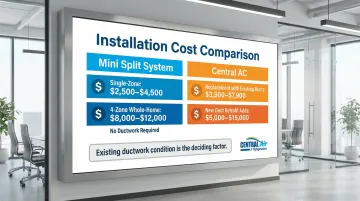
Mini Split: Higher per-zone cost with no ductwork required, but each zone needs its own indoor unit. A single-zone system typically runs $2,500–$4,500, while a 4-zone system for whole-home coverage ranges from $8,000–$12,000.
Central AC: Lower per-unit cost when ductwork already exists—typically $3,900–$7,900 for replacement. However, retrofitting new ducts adds $5,000–$15,000 to the project, making mini splits the more economical choice.
Energy Efficiency
Mini Split: Generally achieves higher SEER2 ratings (up to 32.2 vs. the regional minimum of 14.3) with zero duct losses. Zone-only operation means you cool only the rooms in use.
Central AC: Duct leakage in unconditioned attics—common in older Texas homes—can lose 20–30% of conditioned air, reducing real-world efficiency even in high-SEER units.
Best Use Case
Mini Split is the better fit for:
- Homes without existing ductwork
- Room additions, converted garages, and home offices
- Households where occupants want independent temperature control per room
Central AC works best for:
- Homes with quality existing ductwork already in place
- Larger open-plan layouts that benefit from uniform airflow
- Homeowners who prefer managing whole-home comfort from a single thermostat
What Is a Mini Split System?
A mini split is a ductless HVAC system consisting of an outdoor compressor/condenser connected to one or more wall-mounted indoor air handlers through a small conduit—no ductwork required. This design is gaining popularity in Texas because it eliminates the efficiency losses that plague traditional ducted systems running through superheated attics.
How Zoned Cooling Works
Each indoor unit operates independently via remote or app control. Your living room can stay at 74°F while an unused guest bedroom isn't cooled at all. For Texas homeowners running AC 8+ months a year, this flexibility translates to measurable savings—you're not paying to cool spaces nobody's using.
Core Efficiency Benefits
Modern mini splits achieve SEER2 ratings up to 32.2, far exceeding the Department of Energy's 2023 regional minimum of 14.3 SEER2 for central systems. Eliminating duct losses matters enormously in Bryan's climate. When attic temperatures hit 120–180°F in summer, ducts routed through those spaces lose 20–30% of conditioned air through leakage and heat gain. Mini splits sidestep that loss entirely.
What Installation Looks Like
A licensed HVAC technician drills a small hole through the exterior wall, mounts the indoor unit, runs the refrigerant conduit, and connects to the outdoor unit. Installation is usually faster and less disruptive than retrofitting ductwork, making it practical for older homes or additions where a ducted system would require tearing into walls and ceilings.
Mini splits work particularly well in these Bryan, TX situations:
- Older homes without existing ductwork where installing ducts would cost $5,000–$15,000
- New room additions like sunrooms, converted garages, or bonus rooms where extending ductwork is impractical
- Home offices that run all day while the rest of the house doesn't need cooling
- Multi-story homes where upstairs bedrooms trap heat and need more cooling than downstairs
That said, mini splits have real trade-offs. Visible wall units don't suit every aesthetic. Beyond 4–5 zones, costs climb quickly—at that scale, central AC is usually more economical for whole-home uniform cooling.
What Is Central AC?
Central air conditioning uses an outdoor condenser unit and indoor air handler to distribute conditioned air throughout your home via a network of ducts and vents, controlled by a single thermostat or zoned smart thermostat system.
Core Benefits for Bryan Homeowners
- Consistent temperature throughout the home without visible equipment in living spaces
- Single-point control compatible with smart thermostats for scheduling and energy management
- Ducts run through walls and attic, vents in ceiling or floor — no visible indoor units
- Lower replacement cost when quality ductwork is already in place
The Texas-Specific Drawback
Ductwork routed through unconditioned attic spaces—common in Bryan-area homes—creates a serious efficiency problem. When attic temperatures soar above 130°F in summer, poorly sealed or insulated ducts can lose 20-30% of conditioned air. A Texas A&M study found that a 9.1% return air leak from a 130°F attic caused a 15.3% drop in effective cooling efficiency.
Use Cases of Central AC in Texas
Central AC is the right call when:
- Existing ductwork is in good condition — makes replacement ($3,900–$7,900) far more cost-effective than a whole-home mini split install
- You have a larger open-plan home where even temperatures across all rooms are a priority
- You prefer hidden equipment with no visible indoor units in living spaces
Mini Split vs. Central AC: Which Is Better for Your Texas Home?
Texas Climate Factor
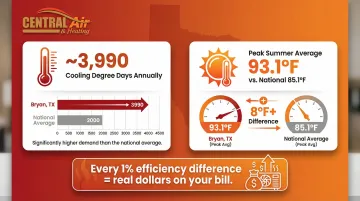
Bryan's climate means your AC runs longer and harder than most of the U.S. The region experiences approximately 3,990 cooling degree days annually—a massive cooling load that's more than three times the heating requirement. During peak summer months, Bryan averages 93.1°F compared to the national average of 85.1°F.
This extended cooling season amplifies both the benefits of mini split efficiency and the cost of central AC duct losses, so every percentage point of efficiency difference translates directly to dollars on your utility bill. The longer your system runs, the more those duct losses cost you—and in Bryan, it runs a lot.
That operating context shapes every factor below. Start with the most structurally decisive one: ductwork.
The Ductwork Question Is Decisive
If your home has no ductwork, installing it just to run central AC adds $5,000–$15,000 and significant disruption—in those cases, mini splits almost always make more financial sense. Conversely, if quality ductwork already exists, replacing a central AC unit is typically the more cost-effective path.
Ducts older than 20 years often lose efficiency even if they appear visually intact. Have Central Air & Refrigeration's technicians inspect your ductwork condition before committing to either path.
Zoning Needs and Lifestyle
Families with varying comfort preferences, home offices, upstairs bedrooms that overheat, or vacation homes where only certain rooms are used regularly will get tangible value from mini split zoning. Central AC suits households that want simple, whole-home comfort from a single thermostat.
Once you've matched the system to your comfort needs, the next question is what it actually costs to own over time.
Long-Term Cost of Ownership
Frame this as upfront cost vs. operating cost. Mini-split systems can deliver 30-40% savings on energy bills compared to central systems by eliminating duct losses. Heat pumps (including mini-splits) are projected to save Texas households approximately $300 annually.
Payback periods vary, but high-efficiency mini-splits in hot-humid climates typically recover their cost premium within 10–15 years through energy savings alone. Maintenance costs differ too: mini split filters need monthly cleaning, while central systems require filter changes plus periodic duct sealing.
Situational Recommendations
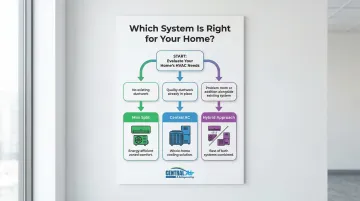
Choose a mini split if:
- Your home lacks ductwork
- You're adding a new room or converting a garage
- You want room-by-room temperature control
- Your existing ducts are in poor condition
Choose central AC if:
- You have functional existing ductwork
- You prefer whole-home uniformity
- You're cooling a large open floor plan
Consider a hybrid approach: Central AC for main living areas plus a mini split for a problem room or addition is a practical solution many Bryan homeowners don't consider. The team at Central Air & Refrigeration can assess your home's layout, ductwork condition, and cooling needs to recommend the right fit before you invest.
Conclusion
Both systems work — the right one depends on your home. Mini splits make more sense for homes without ducts, rooms needing targeted comfort, and homeowners willing to invest upfront for long-term energy savings. Central AC is the practical choice when you already have quality ductwork and need whole-home cooling on a tighter budget.
Bryan's climate makes getting this choice right more impactful on your utility bills than in most parts of the country. With an 8-month cooling season and summer temperatures consistently 8–10°F above the national average, the efficiency differences between these systems compound month after month.
The best way to make this decision is to have a licensed HVAC technician evaluate your specific home—not rely on a generic internet checklist. Reach out to Central Air & Refrigeration at (979) 324-6791 for a straightforward assessment and installation quote from a team with 10+ years of local Bryan, TX experience.
Frequently Asked Questions
How much does a mini split cost for a 2000 sq ft house?
A 2,000 sq ft home typically needs a 4-zone mini split system, with costs ranging from $8,000 to $15,000+. Final price varies based on the number of zones, SEER2 rating, and whether electrical upgrades are required.
Do you need a permit to install a mini split in Texas?
Yes, most Texas municipalities require an HVAC permit for mini split installation, including Bryan. Working with a licensed HVAC contractor like Central Air & Refrigeration ensures permit requirements are handled correctly and your installation meets local safety codes.
Which is better, central air or ductless?
The right choice depends on your home's setup. Central air suits ducted homes that want whole-home comfort with equipment out of sight. Ductless is the better fit for homes without existing ductwork, or anywhere room-by-room temperature control matters.
Are ductless AC units worth it?
In a climate like Bryan, TX—where AC runs 8+ months a year—ductless units typically deliver 30–40% energy savings over time. That return, combined with zone-level flexibility, usually justifies the higher upfront cost, especially when duct installation isn't already in place.
Do mini splits work in Texas?
Yes, mini splits perform very well in Texas's hot, humid climate. Modern inverter-driven models handle dehumidification well, and Texas's minimal heating demand (only 1,200 heating degree days annually) makes the mini split's heat pump function a convenient bonus rather than a necessity.
Why is my electric bill so high with mini split?
The most common causes are an incorrectly sized unit, dirty filters cutting airflow (clean them monthly), or an improper refrigerant charge from installation. Running multiple zones at full capacity simultaneously also spikes consumption. Contact Central Air & Refrigeration for a system evaluation if your bills seem unexpectedly high.