

Introduction
Picture this: it's mid-July in Bryan, Texas. The temperature hit 102°F by noon, and your old AC finally gave up. Now you're shopping for a replacement, and every contractor seems to recommend a different size unit. One says 3 tons, another insists on 4, and a third claims 3.5 is the "sweet spot." The stakes are real: choose wrong and you'll pay for it every month — in higher energy bills, constant repairs, and a home that never quite feels comfortable.
In Texas, air conditioning can account for 50-70% of your summer electric bill. Getting the size right isn't a minor detail — it directly affects your comfort, your monthly costs, and how long your equipment lasts.
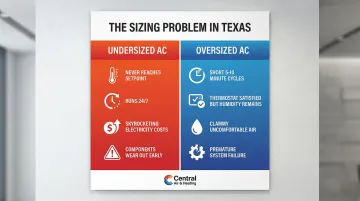
An undersized unit runs nonstop trying to keep up with 100°F+ heat, driving up costs and breaking down early. An oversized unit blasts cold air for five minutes, shuts off, and leaves your home feeling clammy because it never ran long enough to pull humidity from the air.
Key Takeaways
- Most Texas homes need 2–5 tons of cooling, but square footage is just the starting point
- One ton covers roughly 400–600 sq ft in Texas's hot, humid climate — more conservative than national averages
- Factors like insulation, ceiling height, window count, and ductwork condition can all push your sizing up or down
- A Manual J Load Calculation by a certified HVAC technician is the only accurate sizing method
- Right-sizing your AC lowers your energy bills, extends equipment life, and keeps your home consistently comfortable
Why Getting Your AC Size Right Matters More in Texas
Texas doesn't just have hot summers—it has long, punishing, humid summers. In Bryan and the Brazos Valley, you're running your AC hard for 5-6 months straight. College Station's weather station records an average of 15 days per year at or above 100°F, but recent years have been more extreme—2023 saw a record-breaking 75 days of triple-digit heat.
This relentless heat load makes AC sizing more consequential here than in cooler states. Two failure modes dominate:
- Undersized units run 24/7 trying to catch up. They never reach the thermostat setpoint on the hottest days, electricity costs skyrocket, and components wear out from constant operation.
- Oversized units blast cold air for 5-10 minutes, satisfy the thermostat, then shut off before removing humidity. The result is a home that feels cold but clammy—and a system that fails years ahead of schedule.
The financial stakes are real. In Texas, air conditioning accounts for approximately 18% of annual residential electricity use—well above the national average. During peak summer months, cooling can drive 50-70% of your total electric bill. An improperly sized system wastes a substantial portion of that expense while delivering worse comfort.
AC Sizing 101: Understanding BTUs, Tons, and Square Footage
AC sizing starts with two terms every homeowner in Bryan should know: BTUs and tons.
What is a "Ton" of Cooling? In HVAC, a ton doesn't refer to weight. One ton of cooling equals 12,000 BTUs per hour (British Thermal Units). BTUs measure how much heat an air conditioner can remove from your home in one hour. A 3-ton unit, for example, removes 36,000 BTUs per hour.
Climate Zone Context Bryan, TX sits in Climate Zone 2A (Hot-Humid) under the International Energy Conservation Code. This classification matters because your system must handle both high sensible loads (temperature) and significant latent loads (humidity)—a tougher job than dry-heat climates or moderate zones.
Texas AC Sizing by Square Footage: A Starting Point
Square footage gives a rough baseline, but Texas's extreme climate shifts the math. National rules of thumb (1 ton per 600-800 sq ft) don't apply here.
Texas-Adjusted Sizing Estimate:
- Well-insulated newer homes: 1 ton per 500-600 sq ft
- Older or poorly insulated homes: 1 ton per 400-500 sq ft
Estimated Tonnage by Home Size (Texas Climate):
| Home Size (sq ft) | Estimated Tonnage |
|---|---|
| 1,200 - 1,500 | 2.0 - 2.5 tons |
| 1,500 - 2,000 | 3.0 - 3.5 tons |
| 2,000 - 2,500 | 3.5 - 4.0 tons |
| 2,500 - 3,000 | 4.0 - 5.0 tons |
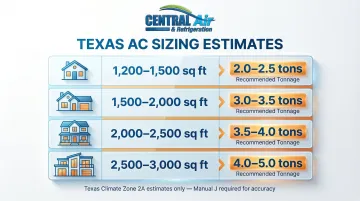
Critical caveat: This table is a starting estimate only. Actual sizing can shift by half a ton or more based on insulation, ceiling height, windows, and ductwork—factors we'll cover next.
Why Bigger Is Not Always Better
Many homeowners assume a bigger AC is the safer bet. In practice, oversizing creates three real problems that show up fast in Bryan's humid summers.
Short-cycling happens when an oversized unit cools the space so quickly it shuts off before completing a full run cycle. Air conditioners are least efficient at startup — they need time to reach peak operating efficiency. Short-cycling keeps them stuck in that inefficient phase, reducing overall system efficiency by 15-20%.
Humidity buildup is the more uncomfortable consequence. In Climate Zone 2A, your AC removes moisture by running long enough for it to condense on the evaporator coil. Cut the cycle short and that process never finishes. The result: a home that reads 72°F on the thermostat but still feels sticky.
Accelerated wear rounds out the damage. Compressors, capacitors, and contactors handle constant on-off cycling poorly. Each unnecessary startup shortens the system's service life — the opposite of what a major equipment investment should deliver.
The goal isn't the biggest unit you can buy. It's the right-sized unit running steady, efficient cycles.
Key Factors That Affect Your AC Size Beyond Square Footage
Square footage provides a floor estimate, but your home's actual heat load depends on several variables that can push sizing requirements up or down significantly. These are what professionals assess before recommending a unit.
Insulation Quality and Home Age
Older homes in the Bryan area—especially those built before 1990—often have inadequate insulation in attics and walls. Poor insulation allows significant heat gain during summer, requiring a larger capacity system to compensate. A well-insulated newer home built to modern standards may actually need less cooling capacity than the square footage estimate suggests.
If your attic insulation is thin or compressed, or if you have single-pane windows and minimal wall insulation, expect to need more tonnage than the baseline calculation.
Ceiling Height and Home Layout
Most sizing estimates assume standard 8-foot ceilings. Vaulted or 10-12 foot ceilings dramatically increase the volume of air that needs cooling. An open floor plan with high ceilings in a 2,000 sq ft Texas home may require as much cooling as a 2,500 sq ft home with standard ceilings.
High ceilings don't just add volume—they also create stratification, where hot air rises and sits at the top of the room, forcing the AC to work harder to maintain comfort at living level.
Windows: Number, Size, and Orientation
Large windows, especially those facing west or south in Texas, allow intense solar heat gain throughout the afternoon. The number of windows, their age (single vs. double pane), and their orientation are all factors that increase or decrease cooling load.
A sun-drenched living room with floor-to-ceiling west-facing windows can require significantly more BTUs than the square footage alone suggests. Older single-pane windows are particularly problematic, as they offer minimal resistance to heat transfer.
Sun Exposure, Shade, and Outdoor Environment
Homes with mature trees, covered patios, or north/east-facing orientations benefit from natural shading that meaningfully reduces cooling demand. A home shaded by large oaks may need a smaller unit than an identical home in full sun.
A new construction home in a treeless Bryan subdivision with a dark roof and no landscaping will need additional cooling capacity. Roof color matters too—dark shingles absorb more heat than light-colored roofing, increasing attic temperatures and heat transfer into living spaces.
Ductwork Condition and Attic Location
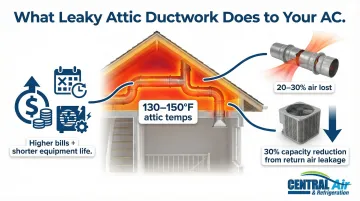
Leaky or poorly insulated ducts are a major source of energy waste, especially in Texas homes with attic ductwork. Attic temperatures in summer can reach 130°F to 150°F. Research shows that return air leakage from hot attics can reduce an air conditioner's effective capacity by approximately 30%.
The U.S. Department of Energy estimates that typical residential duct systems lose 20-30% of the air that moves through them due to leaks, holes, and poorly connected ducts. The downstream effects include:
- Increased strain on the AC unit, shortening its lifespan
- Contractors installing oversized equipment to compensate for air loss
- Higher energy bills that persist until the ductwork is actually repaired
Why a Manual J Load Calculation Is the Right Way to Size an AC in Texas
To avoid guesswork and costly mistakes, the HVAC industry relies on a standardized engineering method.
What Is Manual J?
Manual J is the residential load calculation procedure published by the Air Conditioning Contractors of America (ACCA). It's the only method recognized by the American National Standards Institute (ANSI) for proper HVAC sizing. Manual J accounts for every variable affecting a home's cooling load:
- Square footage and ceiling heights
- Insulation values in walls, attic, and floors
- Window areas, types, and orientations
- Local climate data (temperature, humidity)
- Occupancy and heat-generating appliances
- Ductwork location and condition
Required by Texas Code
Using Manual J isn't just best practice—it's the law for new installations. Texas state energy code (based on the International Residential Code) explicitly states that heating and cooling equipment "shall be sized in accordance with ACCA Manual S based on building loads calculated in accordance with ACCA Manual J."
The Cost of Skipping It
Despite the requirement, many contractors still skip this step, relying instead on square footage rules of thumb or simply matching the size of the old unit. A study of nearly 5,000 energy audits in Texas found that 31% of residential systems were oversized, a direct result of failing to perform accurate load calculations. This oversizing contributed to 18-20% potential cooling energy savings being left on the table.
What a Proper Calculation Delivers
A Manual J-based recommendation means the selected unit is neither too big nor too small for your specific home. This translates directly to:
- Lower monthly energy bills
- More consistent temperatures throughout the home
- Better humidity control
- Longer equipment lifespan
- Fewer repairs
In Bryan and the surrounding Brazos Valley, where AC runs six or more months a year, getting the size right from the start is one of the highest-impact decisions you'll make for your home's comfort and long-term costs.
How Central Air & Refrigeration Helps Bryan, TX Homeowners Get Sizing Right
Choosing the right AC size isn't about guesswork or generic online calculators—it requires local expertise and a systematic assessment process.
Local Knowledge Matters
Central Air & Refrigeration has served Bryan, TX for over 10 years, building deep familiarity with the area's climate, construction styles, and Central Texas humidity demands. A contractor who knows Bryan's building patterns—from older neighborhoods near downtown to newer subdivisions off Highway 6—will size your system more accurately than any generic calculator.
The Assessment Process
When you contact Central Air & Refrigeration, their certified technicians conduct a full home assessment that includes:
- Evaluating your home's square footage and layout
- Inspecting insulation quality in attics and walls
- Assessing ceiling heights and room volumes
- Documenting window sizes, types, and orientations
- Evaluating existing ductwork condition and location
- Considering your comfort preferences and efficiency goals

Transparent Pricing, No Surprises
Central Air & Refrigeration provides upfront quotes with no hidden fees. You'll know exactly what you're getting before any work begins—equipment, labor, and timeline all clearly spelled out.
Certified Technicians, Quality Installation
All technicians are fully licensed, insured, and certified. With 10+ years in Bryan's HVAC market, they know how to install and commission systems properly—so your unit runs efficiently from day one, not after a costly callback.
Ready to Get Started?
If you're unsure what size AC you need for your Bryan home, call Central Air & Refrigeration at (979) 324-6791. They typically respond within one business day and can schedule your sizing assessment fast—before the next Texas heat wave arrives.
Frequently Asked Questions
What size AC unit do I need in Texas?
Most Texas homes need between 2 and 5 tons depending on square footage and other factors. The Texas climate demands conservative sizing—roughly 1 ton per 400-600 sq ft—compared to national averages. A professional Manual J load calculation gives the most accurate answer for your specific home.
What is the $5000 rule for HVAC?
Multiply your system's age by the estimated repair cost. If the result exceeds $5,000, replacement is typically more cost-effective than repair—for example, a 10-year-old unit facing a $600 repair equals $6,000, suggesting it's time to replace. It's a useful rule of thumb, not a technical standard.
What is the rule of thumb for HVAC sizing?
The general rule is 1 ton per 600-800 sq ft nationally, adjusted to 1 ton per 400-600 sq ft for Texas due to extreme heat load. Treat this as a rough starting point and confirm with a Manual J load calculation for your specific home.
How many sq ft will a 3 ton AC unit cool?
In Texas, a 3-ton (36,000 BTU) unit typically covers 1,200-1,800 sq ft. Well-insulated newer homes land at the higher end, while older homes with high ceilings or west-facing windows may need additional capacity.
Is 18 SEER or 20 SEER better?
A higher SEER rating means greater energy efficiency. A 20 SEER unit uses less electricity to produce the same cooling as an 18 SEER unit, translating to lower monthly bills. In a high-use climate like Texas, the energy savings over time can justify the higher upfront cost of a 20 SEER system.
Can I just match my new AC to the size of my old unit?
No. The old unit may have been improperly sized from the start, and changes to your home over time—new insulation, added rooms, window replacements, ductwork repairs—may mean a different size is now appropriate. Always start fresh with a proper load calculation to ensure optimal sizing.