
Introduction
Texas summers are relentless. Bryan and College Station routinely see temperatures soar past 100°F for weeks on end, making reliable cooling a necessity. Ductless mini split systems have become one of the fastest-growing HVAC solutions in the state because they solve a specific problem: precise room-by-room climate control without the cost of installing ductwork. That growing demand, combined with rising equipment and labor costs, means 2026 pricing looks different than it did just two years ago.
Installation costs in Texas vary widely based on system size, number of zones, brand selection, labor complexity, and local code requirements. Guessing wrong means sticker shock mid-project — or paying for capacity you don't need. This guide breaks down real 2026 price ranges, the factors that move costs up or down, and what a complete quote should include so you can budget accurately from the start.
Key Takeaways
- Ductless mini split installation in Texas typically costs $3,000–$15,000+, depending on system size and zone count
- BTU capacity, zone count, brand, and SEER2 rating drive most of the price variation
- Single-zone systems work well for one room or an addition; whole-home multi-zone setups cost significantly more
- Texas's higher SEER2 minimums and climate demands push sizing requirements — and costs — above national averages
- Federal tax credits (up to 30%) and Texas utility rebates can cut upfront costs by hundreds to thousands of dollars
How Much Does a Ductless Mini Split Installation Cost in Texas?
There is no single fixed price for a ductless mini split installation. The total installed cost combines equipment, labor, permits, and site-specific needs—and Texas pricing tends to run at or slightly above national averages due to the state's intense climate demands.
When homeowners miscalculate sizing, the consequences are costly: undersized systems run constantly and fail prematurely, while oversized units short-cycle and spike humidity, which is a particularly serious problem in Texas's high-humidity climate.
Typical Price Ranges by System Type
Texas homeowners can expect the following installed cost ranges in 2026:
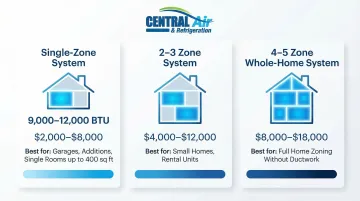
- Single-Zone (9,000–12,000 BTU) — $2,000–$8,000 installed: Best for a home addition, garage, sunroom, or single room up to 400 sq. ft. in Bryan, TX
- 2–3 Zone System — $4,000–$12,000 installed: Suits small homes, rental units, or rooms supplementing an existing HVAC system with independent temperature control
- 4–5 Zone Whole-Home System — $8,000–$18,000 installed: Best for homes without ductwork or owners replacing central air with full room-by-room zoned control
What's Typically Included:
- Outdoor condenser and indoor air handler(s)
- Refrigerant line set (15-25 feet standard)
- Wall mounting hardware and brackets
- Professional labor, vacuum, and refrigerant charging
- Basic electrical whip from disconnect to unit
What's Typically Excluded:
- Electrical panel upgrades ($1,500–$3,000)
- Extended refrigerant line runs ($5–$10 per foot beyond standard)
- Concrete pad installation ($300–$500)
- Wall patching and finishing
- Condensate pump ($120–$280 if gravity drainage isn't possible)
Cost by System Size (BTU and Square Footage)
Texas's extreme heat means homes here require more cooling capacity per square foot than national guides suggest. Use this table as a starting reference:
| Room Size (sq. ft.) | Texas BTU Requirement | Estimated Installed Cost |
|---|---|---|
| 150–250 | 9,000 BTU | $2,000–$5,500 |
| 300–400 | 12,000 BTU | $2,500–$6,800 |
| 450–550 | 18,000 BTU | $3,500–$9,200 |
| 600–1,000 | 24,000 BTU | $4,500–$12,000 |
| 1,500 sq. ft. home | 30,000–36,000 BTU (multi-zone) | $8,000–$15,000 |
| 2,000 sq. ft. home | 36,000–48,000 BTU (multi-zone) | $10,000–$18,000 |
Texas's heat load, combined with high humidity and direct sun exposure, often pushes capacity requirements 20–25% higher than milder climates—which is why a Manual J load calculation matters more here than generic square footage rules. Zone count affects cost just as much as raw BTU capacity.
Cost by Number of Zones
Each additional indoor air handler adds both equipment cost ($400–$1,800 per unit) and labor cost. Larger systems also require more powerful outdoor condensers:
- 1 Zone: $2,000–$8,000 installed
- 2 Zones: $4,000–$10,000 installed
- 3 Zones: $6,000–$12,000 installed
- 4 Zones: $8,000–$15,000 installed
- 5 Zones: $10,000–$18,000 installed
Multi-zone installations add more labor hours due to running multiple refrigerant line sets, drainage lines, and electrical connections through attics, crawlspaces, or exterior conduit.
Key Factors That Affect Mini Split Installation Cost in Texas
Beyond system size, five variables consistently separate a $4,000 install from a $12,000+ one in Texas.
System Type and Configuration
Single-zone systems pair one outdoor condenser with one indoor unit. Multi-zone systems connect one condenser to 2–5 indoor units, allowing independent temperature control per room — more expensive upfront, but far more cost-effective than running multiple separate single-zone systems.
Indoor unit style affects both equipment and labor costs:
| Unit Type | Relative Cost | Best For |
|---|---|---|
| Wall-mounted | Lowest | Most rooms; easiest install |
| Floor-mounted | Mid-range | Rooms without suitable wall space |
| Ceiling cassette | Higher | Open-plan spaces; cleaner ceiling look |
| Concealed ducted | Highest | Hidden installation with short duct runs |
Heat pump models (cooling + heating) run $200–$500 more than cooling-only units. For most Texas homes, that premium is worth it — you get year-round use without the cost of a separate furnace, and Texas winters are mild enough that a heat pump handles them comfortably.
BTU Capacity and SEER2 Rating
Texas falls under the Southwest HVAC efficiency region, which mandates a minimum 14.3 SEER2 rating for new systems as of 2023—higher than the 13.4 SEER2 national baseline. Higher-efficiency units (18–25 SEER2) cost $500–$2,000 more upfront but reduce operating costs meaningfully.
In hot climates where AC runs 7–9 months per year, high-SEER2 systems can reduce cooling costs by approximately 30% compared to baseline models. For a Texas home, that translates to $150–$300 in annual savings — a payback period of roughly 3–5 years on the efficiency premium.
Brand Selection
Brand affects both equipment cost and long-term reliability. Here's how common brands compare in the Texas market:
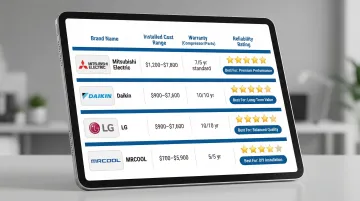
| Brand | Installed Cost Range | Warranty (Compressor/Parts) | Reliability Notes |
|---|---|---|---|
| Mitsubishi Electric | $1,200–$7,800 | 7/5 years (up to 12/12 with Diamond Contractor) | Top-tier reliability; excellent low-ambient heating performance |
| Daikin | $900–$7,600 | 10/10 years (12/12 on select models) | Strong warranty; manufacturing presence in Texas |
| LG | $900–$7,600 | 10/10 years (requires registration) | Good value; widely available parts |
| MRCOOL | $700–$5,900 | 5/5 years standard | Popular DIY option; shorter warranty and mixed pro support |
Budget brands save money upfront but often mean shorter warranties and more service calls over time. Premium brands like Mitsubishi and Daikin hold up better in extreme Texas heat and tend to last longer overall.
The brand you choose shapes the equipment cost — but once you've picked a system, installation and site conditions determine how much labor adds to the total.
Labor, Permits, and Site Complexity
Labor costs vary by job scope:
- Single-zone installation: $300–$2,000
- Multi-zone installation: $700–$3,000+
Permit Fees: Texas municipalities (including Bryan) generally require mechanical permits ranging from $250–$400 for mini split installations, especially multi-zone systems.
Site Complexity Factors That Raise Labor Costs:
- Long refrigerant line runs (charged at $5–$10 per linear foot beyond standard 15–25 feet)
- Second-story or difficult-access mounting locations
- Concrete pad installation for ground-mounted condensers
- Wall sleeve coring through brick or concrete
- Attic or crawlspace line runs requiring extensive routing
Electrical Upgrades
Many Texas homes—especially older ones—need a dedicated 240V circuit to support a new mini split. Adding a dedicated circuit typically costs $250–$600 in Texas, with electricians charging $50–$100 per hour. Homes with insufficient panel capacity may need a full panel upgrade ($1,500–$3,000), which adds meaningfully to the total project cost.
Full Cost Breakdown: What You're Actually Paying For
A mini split invoice covers more than just the unit. Knowing each line item helps you compare quotes accurately and avoid surprises at project close.
Equipment (One-Time)
The outdoor condenser and indoor air handler(s) represent 50-70% of total project cost. Prices vary by BTU, zones, brand, and SEER2 rating. Buying a pre-charged DIY kit can reduce equipment cost, but most Texas HVAC contractors install their own sourced equipment and will not warranty third-party units.
Installation and Labor (One-Time)
Labor covers the full scope of work to get the system running:
- Mounting indoor and outdoor units
- Running and connecting refrigerant lines
- Completing electrical connections
- Commissioning and system testing
Multi-zone installs require considerably more labor hours, so always request an itemized quote. Confirm that nitrogen pressure testing and vacuum pull-down are included — skipping these steps shortens system life well before the 15-20 year mark.
Permits and Inspection (One-Time)
Required for most mini split installations in Texas, especially multi-zone systems. Factor $250–$400 for permits in Bryan and surrounding municipalities. Unpermitted work can affect homeowner's insurance and future home sales.
Operating Costs (Recurring)
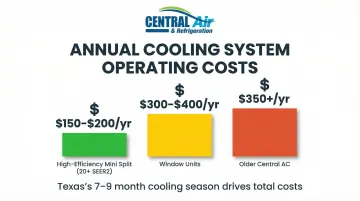
Mini splits are generally more efficient than window units and comparable to or better than many central systems. However, Texas's long cooling season means substantial runtime. A properly sized high-efficiency mini split (20+ SEER2) typically costs $150–$200 annually to operate, compared to $300–$400 for window units and $350+ for older central AC systems.
Maintenance and Repairs (Recurring/Periodic)
Annual maintenance (filter cleaning, coil inspection, refrigerant check) typically runs $100–$200 per visit. Budget for refrigerant refills, capacitor replacements, and eventual compressor service over a 15-20 year lifespan. Skipping maintenance in Texas's dusty, humid environment cuts years off equipment life.
Why Texas Homes Often Pay More Than the National Average
National pricing guides are useful benchmarks, but Texas homeowners in Bryan and the Brazos Valley region should plan for costs at or above the midpoint of those ranges for several specific reasons.
Texas Climate Demands Higher Capacity
Texas's extreme summer heat and high humidity mean homes here typically need higher BTU systems than the same square footage would require in milder climates. A room that a 9,000 BTU unit could handle in Ohio may need 12,000 BTUs in Bryan, TX—directly increasing equipment and potentially labor costs.
Contributing Factors:
- Heat gain from intense direct sun exposure
- Poor insulation common in older Texas homes
- High outdoor temperatures (100°F+ for 30+ days annually in Bryan/College Station)
- Humidity load requiring systems to remove moisture as well as cool air
Southwest SEER2 Requirements and New Refrigerant Regulations
Texas contractors must install systems meeting the Southwest region's 14.3 SEER2 minimum as of 2023, which is higher than the 13.4 SEER2 national baseline. Additionally, the 2025 refrigerant regulation transition has impacted equipment pricing.
As of January 1, 2026, new R-410A system installations are restricted. The industry has shifted to R-32 and R-454B (A2L refrigerants), which offer lower global warming potential but carry a 10-15% equipment price increase.
Homeowners should confirm they're being quoted for R-32 or R-454B systems. R-410A refrigerant will become increasingly expensive and difficult to source for repairs, making long-term serviceability a real concern for any system installed on the old standard.
Where Texas Homeowners Can Save
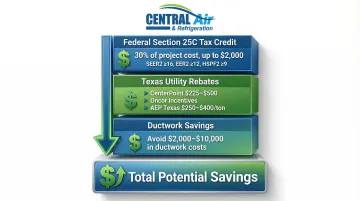
Despite higher capacity needs, Texas homeowners in areas without existing ductwork actually save significantly compared to installing central AC. Retrofitting a home with new ductwork costs $2,000–$10,000+, often requiring soffits, closet modifications, or attic work. Skipping that entirely is where mini splits deliver real savings. Common scenarios where this advantage applies most:
- Older homes built without central air
- Converted garages or workshops
- Home additions and sunrooms
- Accessory dwelling units (ADUs)
How to Get the Best Price on Your Mini Split Installation in Bryan, TX
The lowest quote is rarely the best value. The goal is finding the right system, properly installed, at a fair and transparent price.
Get Multiple Itemized Quotes
Ask each contractor to specify exact model numbers, BTU capacity, SEER2 rating, line set length included, permit fees, and what commissioning steps are performed. This prevents apples-to-oranges comparisons.
Central Air & Refrigeration provides transparent, upfront quotes with no hidden fees. Homeowners in Bryan, TX can call (979) 324-6791 to schedule an on-site assessment.
Stack Available Rebates and Tax Credits
The federal Section 25C tax credit covers 30% of the project cost up to $2,000 for qualifying heat pump mini split systems. To qualify, systems must meet CEE Tier 1 standards (SEER2 ≥ 16, EER2 ≥ 12, HSPF2 ≥ 9).
Texas utility companies also offer rebates:
- CenterPoint Energy: $225–$500+ for high-efficiency heat pumps
- Oncor: Incentives for residential HVAC upgrades through participating providers
- AEP Texas: $250–$400 per ton for qualifying systems
Verify eligibility before purchase by checking your utility provider's website or the Database of State Incentives for Renewables & Efficiency (DSIRE).
Time Your Installation Strategically
Once you've confirmed your rebate eligibility, locking in your installation date at the right time can stretch your budget further. Demand for HVAC contractors in Bryan spikes every April–May as homeowners prepare for summer. Scheduling in fall or winter typically means faster availability and better pricing. Avoid the post-winter rush when homeowners scramble after the first heat wave of the year.
Frequently Asked Questions
How much does it cost to install a mini split in Texas?
Single-zone systems typically cost $2,000–$8,000 installed, while multi-zone whole-home systems range from $8,000–$18,000. Texas pricing runs at or above national midpoints due to climate demands requiring higher BTU capacity and the Southwest region's 14.3 SEER2 minimum efficiency requirement.
How much does a mini split installation cost for a 2,000 sq ft house in Texas?
A 2,000 sq ft Texas home typically requires a 36,000–48,000 BTU multi-zone system, with installed costs ranging from $10,000–$18,000. The final number depends on your home's layout, insulation quality, sun exposure, and the number of zones needed for optimal comfort.
How much does it cost to install two mini split units in Texas?
A 2-zone system (one outdoor condenser, two indoor handlers) typically costs $4,000–$10,000 installed. Installing two completely separate single-zone systems costs significantly more ($4,000–$16,000) since each requires its own outdoor condenser and separate labor.
What is the 30% tax credit for mini splits?
The federal Section 25C Energy Efficient Home Improvement Credit offers 30% of the project cost (capped at $2,000) for qualifying heat pump systems. To qualify, your mini split must meet specific thresholds: SEER2 ≥ 16, EER2 ≥ 12, and HSPF2 ≥ 9. The system must be installed in your primary residence.
How many mini splits do I need for a 1,500 sq ft house in Texas?
A 1,500 sq ft Texas home typically needs a 2–3 zone system with 30,000–36,000 BTU total capacity. Always validate sizing with a Manual J calculation — insulation, window quality, and sun exposure all shift the numbers more than square footage alone.
Is a ductless mini split worth it in Texas?
For most Texas homeowners, yes. Mini splits reduce utility bills by 20–30%, eliminate the $2,000–$10,000 cost of new ductwork, and deliver zone-by-zone temperature control. With 7–9 months of cooling season, most installations pay back within 5–7 years.