Introduction
When your walk-in cooler stops cooling, the clock starts ticking on thousands of dollars in spoiled inventory, potential health code violations, and lost revenue. For restaurants, grocery stores, and medical facilities in Bryan, TX that depend on consistent refrigeration around the clock, a cooling failure isn't just an inconvenience—it's a business emergency.
Fortunately, most walk-in cooler failures trace back to seven predictable causes. Some you can address yourself before a technician arrives. Others require a certified refrigeration professional. Either way, knowing which problem you're dealing with is the fastest path back to safe temperatures.
Key Takeaways
- The 7 most common causes: incorrect thermostat settings, dirty condenser coils, faulty door gaskets, fan motor failure, low refrigerant, compressor problems, and defrost system malfunction
- Thermostat settings and gasket checks are operator-fixable — refrigerant leaks and compressor failures need a licensed technician
- Catching problems early prevents repeat failures and protects your inventory from spoilage
- If cooling doesn't recover within a few hours of basic troubleshooting, call a certified professional immediately
How a Walk-In Cooler Works: A Quick Overview
Understanding the refrigeration cycle helps you pinpoint where failures occur. Your walk-in cooler operates on a vapor-compression cycle with four critical stages:
- Compression - The compressor pumps refrigerant gas, raising its pressure and temperature
- Condensation - High-pressure gas flows through condenser coils, releasing heat to outdoor air and condensing into liquid
- Expansion - Liquid refrigerant passes through an expansion valve, dropping in pressure and temperature
- Evaporation - Inside the cooler, evaporator coils absorb heat from the air, boiling refrigerant back into gas to repeat the cycle
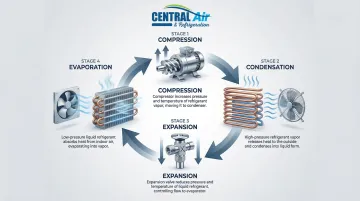
Every component in this closed-loop system depends on the others. One failed part — a dirty coil, broken fan, or refrigerant leak — throws off the entire cycle, and every failure shows up the same way: the unit isn't cold enough.
For FDA Food Code compliance, walk-in coolers storing perishables must stay at or below 41°F. Most operators target 35–38°F to build in a buffer against bacterial growth.
The 7 Most Common Reasons Your Walk-In Cooler Isn't Cooling
Most walk-in cooler failures follow predictable patterns. Identifying the specific cause is more important than guessing—each cause below includes what to look for and what to do about it.
Cause 1: Thermostat or Temperature Control Set Incorrectly
Symptoms to look for:
- Unit runs constantly but never reaches target temperature
- Shuts off too early and interior is warmer than set point
- Thermostat dial was accidentally bumped or adjusted
The Fix:
Verify the set point matches your required storage temperature—typically 35–38°F for coolers. If resetting doesn't resolve the issue after a full cooling cycle, the thermostat itself may be faulty.
Mechanical thermostats are prone to calibration drift and contact corrosion over time. Digital controllers present different problems—sensor failures (such as a false 99°F reading) or relay failures on the circuit board.
Troubleshooting either type often requires checking programmed parameters against manufacturer manuals, since generic replacements may involve complex rewiring.
Cause 2: Dirty or Blocked Condenser Coils
Symptoms to look for:
- Unit runs longer than usual
- Compressor feels excessively hot to the touch
- Cooling performance has gradually declined over weeks or months
- Visible dust, grease, or debris buildup on condenser coil
The Fix:
Dirty coils force the compressor to run hotter and longer. An overheating compressor can increase energy costs by approximately 20% and shorten equipment lifespan.
Condenser coils should be cleaned every 1–3 months—monthly in high-grease kitchen environments. A surface brush-down helps, but a professional cleaning with proper coil cleaner fully restores heat transfer efficiency and protects the compressor long-term.
Cause 3: Faulty or Leaky Door Gaskets
Symptoms to look for:
- Condensation or frost around the door frame
- Cold air visibly escaping when door is closed
- Unit runs constantly but can't maintain temperature
- Dollar-bill test failure—if a bill slides out easily when the door is shut, the seal is compromised
The Fix:
Worn or torn gaskets can increase energy consumption by up to 15% while jeopardizing temperature stability. Continuous air leaks lead to temperature fluctuations and ice buildup on evaporator coils, forcing the system to work harder.
Check for debris caught in the gasket first and clean the door seals thoroughly. If the gasket is torn, cracked, or brittle, it needs replacement—gaskets typically last 2–5 years and swapping one out is one of the most cost-effective fixes on this list.
Cause 4: Condenser or Evaporator Fan Motor Failure
Symptoms to look for:
- Audible change in fan noise
- One or both fans not spinning
- Unit running but warm air inside
Understanding the Two Fan Types:
- Evaporator fans circulate cold air inside the walk-in—failure results in warm spots and iced-over coils
- Condenser fans move air across condenser coils to reject heat—failure causes high head pressure and compressor overheating
The Fix:
First check for physical obstructions blocking the fan blades. If the fan is clear but not spinning, the motor has likely burned out or the electrical connection has failed.
Fan motors typically have a service life of 10–15 years. Motor replacement is a professional repair, but it's considerably less expensive than compressor work—catching a fan failure early keeps that cost gap wide.
Cause 5: Low Refrigerant (Refrigerant Leak)
Symptoms to look for:
- System short-cycles (compressor turns on and off rapidly)
- Sight glass shows bubbles
- Suction line is warmer than expected
- Ice forms on evaporator coil in unusual patterns
- Cooling capacity drops progressively
Critical Understanding: Refrigerant doesn't "run out"—low charge always means there is a leak somewhere in the system.
The Fix:
Federal law regulates refrigerant handling—only EPA 608-certified technicians can legally perform this work. As of January 1, 2026, EPA regulations lowered the leak rate threshold for commercial refrigeration systems to 20%, mandating stricter leak repair protocols and documentation.
A certified technician must:
- Locate and seal the leak
- Recharge the system to manufacturer's specified pressure
- Document the repair for compliance
Ignoring a refrigerant leak accelerates compressor damage and can result in regulatory penalties.
Cause 6: Compressor Failure or Failed Start Relay
Symptoms to look for:
- Unit has power but no cooling at all
- Clicking or humming sound without the compressor starting
- Compressor is hot but not running
Before Assuming Compressor Failure:
Check whether it's the start relay—a small, inexpensive component that sends the startup signal. Test the start relay first (shake it—a rattling sound often means it's failed) and replace it if faulty.
If the Compressor Itself Has Failed:
This is the most costly repair. Compressor replacement typically costs $2,200–$3,000 for medium-sized walk-in units. On older systems, this cost often makes replacement a better financial decision than repair—a critical fix-vs.-replace evaluation point.
Cause 7: Defrost System Malfunction or Frost Buildup
Symptoms to look for:
- Visible ice buildup on evaporator coil
- Fans appear to be running but air circulation is restricted
- Unit enters defrost mode but temperature keeps rising
Understanding Defrost Systems:
- Timer-based systems defrost at set intervals (every 6 hours) regardless of need
- Demand defrost systems use sensors to initiate defrost only when ice is detected, improving energy efficiency
The Fix:
Manually defrost the unit first—turn it off and allow ice to melt completely to restore airflow and confirm whether this is the root cause. Then have a technician inspect and replace the defrost timer, heater elements, or termination thermostat as needed to prevent recurrence.
How to Troubleshoot Your Walk-In Cooler Step by Step
Jumping straight to replacement or calling for parts before confirming the cause wastes money and often doesn't resolve the problem. A systematic check takes 15–30 minutes and narrows the field significantly.
Step 1: Start With the Basics
Check that the unit has power:
- Circuit breaker not tripped
- Unit is plugged in and switched on
- Verify thermostat settings haven't been accidentally changed
- Confirm the unit isn't simply in a normal defrost cycle (fans stopped, slight temperature rise)
These four checks resolve a surprising number of "no cooling" calls.
Step 2: Do a Physical Inspection
Walk through each key component visually:
- Inspect the condenser coil for dirt buildup
- Check both fan blades for obstructions or damage
- Examine door gaskets for cracks or gaps
- Check whether the evaporator coil has abnormal ice or frost accumulation
- Note what looks different from normal operation
Step 3: Listen and Monitor the System Running
Turn the unit on (if it was off) and observe:
- Does the compressor start?
- Do both fans run?
- Does the system short-cycle (turning on and off rapidly)?
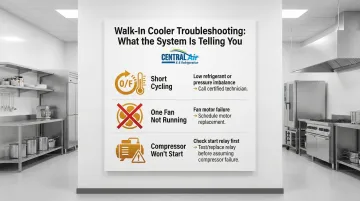
These behavioral clues directly point to specific causes:
- Short cycling — the system may be running low on refrigerant or experiencing pressure imbalances that prevent a full cooling cycle
- One fan not running — the motor for that fan has likely failed and needs replacement before airflow is restored
- No compressor start — check for tripped overloads or failed start relays before assuming the compressor itself has seized
Step 4: Call a Certified Technician for Anything Involving Refrigerant, Electrical Components, or the Compressor
If your physical inspection and basic checks don't identify a clear, operator-fixable cause, do not delay. The longer a warm walk-in runs, the greater the risk to stored inventory.
That's when you need a certified technician on-site fast. Central Air & Refrigeration serves businesses in Bryan, TX with same-day diagnostics and 24/7 emergency refrigeration service. Their technicians handle:
- Walk-in cooler diagnostics
- Refrigerant leak detection and repair
- Compressor repair and replacement
- Defrost system troubleshooting
For emergency walk-in cooler repair, call (979) 324-6791 immediately.
When to Fix vs. Replace Your Walk-In Cooler
The fix-vs.-replace decision comes down to the unit's age, what the repair costs relative to replacement, and whether you're dealing with an isolated part failure or a system that's breaking down broadly.
Industry Lifespan Benchmarks
| Component | Typical Service Life |
|---|---|
| Walk-In Cooler (Overall) | 15-20 years |
| Insulated Panels | 25-40+ years |
| Condensing Unit | 10-15 years |
| Compressor | 8-12 years |
The 50% Rule of Thumb
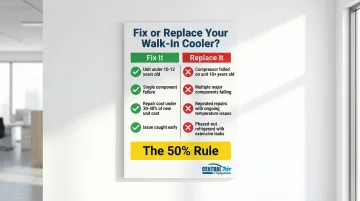
The standard rule of thumb in commercial refrigeration: If the repair cost exceeds 50% of the cost of new equipment, replacement is the smarter financial choice.
Fix When:
- The unit is under 10–12 years old
- The repair involves a single component (gasket, fan motor, start relay, defrost heater)
- The repair cost is less than roughly 30–40% of the cost of a comparable new unit
- Most issues covered in this guide fall into the "fix" category when caught early
Replace When:
- The compressor has failed on a unit older than 10–12 years (compressor replacement on an aging unit rarely makes financial sense)
- Multiple major components are failing simultaneously
- The unit consistently struggles to maintain temperature despite repeated repairs
- Refrigerant leaks are extensive and the refrigerant type has been phased out
Central Air & Refrigeration provides fix-vs.-replace assessments with upfront cost estimates before any major repair — so you know exactly what you're spending and why before work begins.
Preventive Maintenance to Avoid Future Walk-In Cooler Failures
Unplanned commercial refrigeration downtime results in emergency repair premiums, wasted inventory, and lost sales. Implementing a preventive maintenance schedule enhances energy efficiency and extends equipment life.
Recommended Maintenance Intervals
| Task | Frequency |
|---|---|
| Inspect Door Gaskets | Daily / Weekly |
| Clean Condenser Coils | Every 1-3 Months |
| Clean Evaporator Coils | Monthly |
| Refrigerant Leak Check | Quarterly / Annually |
| Professional Inspection | Quarterly |
Note on Leak Checks: For systems with 15-500 lbs of refrigerant, annual inspections are required if the leak rate calculation exceeds the threshold; quarterly inspections are required for larger systems (500+ lbs).
Core Maintenance Tasks
- Condenser coils: Clean every 3–6 months minimum — monthly in high-grease kitchen environments. Dirty coils are the leading cause of compressor overheating and premature failure.
- Door gaskets: Inspect quarterly for wear or gaps. Replace every 2–5 years or when the dollar-bill test fails.
- Refrigerant pressure: Annual professional checks catch developing leaks before system failure and confirm EPA compliance.
- Condenser clearance: Keep the area around the condenser unit free of boxes, supplies, and debris that restrict airflow.
- Staff habits: Train staff to avoid overstocking (which blocks airflow) and never leave the door propped open.
Establish a Professional Maintenance Relationship
Central Air & Refrigeration offers customizable preventive maintenance plans that include bi-annual visits, priority scheduling, repair discounts, and detailed service reports. A professional tune-up catches developing issues—low refrigerant charge, early fan motor wear, frost buildup—before they escalate into a costly emergency call.
Contact (979) 324-6791 to discuss customized maintenance solutions for your Bryan, TX business.
Conclusion
The vast majority of walk-in cooler cooling failures trace back to seven predictable causes—and most can be resolved quickly when identified correctly. Several are addressable by the operator before a technician even arrives: thermostat settings, door gasket checks, and basic visual inspections.
Correct diagnosis is everything. Treating the symptom—adding refrigerant, swapping parts—without confirming the root cause leads to repeat failures. A certified technician's assessment costs far less than the inventory you'll lose guessing wrong.
For businesses in Bryan, TX, Central Air & Refrigeration provides 24/7 emergency refrigeration service with same-day response, transparent pricing, and certified technicians who handle gasket replacements, refrigerant issues, compressor diagnostics, and everything in between. Call (979) 324-6791 at the first sign of trouble—before a cooling problem becomes a spoiled-inventory problem.
Frequently Asked Questions
Why is my walk-in cooler not cooling?
The most common culprits are incorrect thermostat settings, dirty condenser coils, failed fan motors, low refrigerant, or a faulty compressor. A systematic check starting with the simplest causes (power, thermostat, door gaskets) is the fastest path to identifying the issue.
What should I do if my walk-in cooler is not cooling?
Start with power, thermostat settings, and defrost mode, then inspect coils, fans, and door gaskets. If the cause isn't immediately clear or involves refrigerant or electrical components, call a certified technician to prevent inventory loss.
How much does it cost to replace a compressor on a walk-in cooler?
Compressor replacement is the most expensive walk-in cooler repair, typically costing $2,200–$3,000 for medium-sized units. On older units (10+ years), this cost often makes replacement a better financial decision than repair.
How much does a refrigeration technician cost?
Refrigeration technician rates vary by region, scope of work, and whether it's emergency service. Commercial service calls typically range from $100–$250 per hour, with flat "truck roll" fees between $50–$150.
What is the life expectancy of a walk-in cooler?
Well-maintained walk-in coolers typically last 15–20 years. Regular preventive maintenance—coil cleaning every 1-3 months, quarterly gasket inspections, and annual refrigerant checks—is the primary factor in reaching that lifespan.
Can I recharge refrigerant in my walk-in cooler myself?
No. Refrigerant handling requires EPA 608 certification and is illegal for uncertified individuals. Low refrigerant indicates a leak that must be located and sealed before recharging the system to manufacturer specifications.