Introduction
Most Bryan-College Station homeowners will spend somewhere between $150 and $1,800 on AC repairs in 2026 — a range wide enough to be genuinely unhelpful without context. Average highs of 93–98°F and relentless summer humidity mean your system runs nearly non-stop from May through October, and that workload takes a toll.
In 2026, repair costs are shaped by ongoing refrigerant regulations, rising labor demand, and equipment pricing shifts. The EPA's phaseout of older refrigerants like R-22 has made repairs on pre-2010 systems more expensive, while even newer R-410A systems are seeing price increases as production limits tighten.
What you pay depends heavily on the type of repair, your system's age, and your timing — an emergency call at 10 PM on a Saturday costs noticeably more than a Tuesday morning appointment.
This guide covers specific price ranges for common repairs, the factors that push costs up or down, how to weigh repair against replacement, and practical ways to avoid overpaying.
Key Takeaways
- AC repair in Bryan-College Station typically runs $100–$2,500+, depending on the repair — capacitor swaps sit at the low end, compressor work at the high end
- Key cost drivers: repair type, refrigerant type, labor rates, and emergency vs. scheduled service
- If your system is 10+ years old or repair costs exceed half the price of a new unit, replacement is worth considering
- A diagnostic inspection upfront gives you a clear repair cost before any work begins — no surprises
How Much Does AC Repair Cost in Bryan-College Station in 2026?
There's no fixed price for AC repair. Your final bill depends on what's broken, how long the repair takes, the cost of parts, and current labor rates in the Bryan-College Station market.
Homeowners who skip a pricing reality check often make costly mistakes:
- Underbudget and can't cover the full repair when the technician arrives
- Delay action until a $200 capacitor failure becomes a $2,000 compressor replacement
- Replace a unit that only needed a minor fix
Here's what repairs actually cost across three price tiers in 2026.
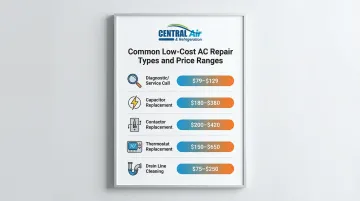
Low-Cost Repairs ($75–$400)
This range covers diagnostic fees, capacitor replacements, contactor replacements, thermostat replacements, and minor refrigerant top-offs. These are single-component fixes a technician can complete in one visit.
What's included:
- Diagnostic/service call fees: $79–$129
- Capacitor replacement: $180–$380
- Contactor replacement: $200–$420
- Thermostat replacement: $150–$650
- Drain line cleaning: $75–$250
These repairs involve low labor time and relatively inexpensive parts. A capacitor or contactor replacement usually takes 30–90 minutes, making them among the most straightforward HVAC fixes.
What's excluded: This range doesn't cover refrigerant recharges when there's an underlying leak, electrical system overhauls, or work on major components like compressors or coils.
Mid-Range Repairs ($400–$1,200)
Mid-range repairs cover more involved labor and costlier parts:
What's included:
- Refrigerant leak detection and full recharge: $400–$1,200+
- Blower motor replacement: $450–$1,000
- Evaporator coil cleaning or minor repair: $400–$900
- Control board replacement: $500–$1,200
Key considerations for 2026: Refrigerant prices have shifted due to EPA phasedown regulations. R-22 (Freon), banned from production since 2020, now costs $90–$150 per pound due to scarcity. A recharge requiring 6–12 pounds can run $660–$2,400 — often exceeding the system's remaining value.
R-410A (Puron), while still legal for servicing existing systems, faces tightening supply as new installations must use low-GWP refrigerants starting in 2025. R-410A now costs $40–$75 per pound, pushing recharge costs higher than in previous years.
Best-fit scenarios: Systems under 10 years old where the repair cost is clearly below the threshold that would justify replacement.
High-Cost Repairs ($1,200–$2,500+)
This range covers compressor replacement, condenser coil replacement, full evaporator coil replacement, and situations requiring multiple simultaneous component repairs.
What's included:
- Compressor replacement: $2,200–$4,800 depending on unit size
- Evaporator coil replacement: $1,400–$3,200
- TXV valve replacement: $750–$1,650
Compressor replacement on an older unit often crosses the financial threshold where replacement becomes smarter. For systems using R-22 refrigerant, compressor replacement can exceed $4,000 and rarely makes financial sense.
What's included: Parts and standard-hours labor. What's excluded: Full system replacement, ductwork modifications, and permits where required.
Emergency or after-hours service calls in Bryan-College Station add a premium — $150–$250 in surcharges — with emergency labor rates reaching $140–$250 per hour.
Key Factors That Affect AC Repair Costs in Bryan-College Station
Pricing is shaped by system-specific, seasonal, and geographic factors that are especially pronounced in Bryan-College Station's climate.
Type and Severity of the Repair
A simple electrical component swap—capacitor or contactor—costs a fraction of what a refrigerant system or compressor repair does. An isolated part failure stays manageable. Cascading damage does not.
A failing capacitor left unaddressed can cause the compressor to overheat and seize — turning a $200 fix into a $3,000+ repair.
Age and Brand of the System
Older units cost considerably more to service. Systems using R-22 refrigerant (common in pre-2010 units) face scarce parts and refrigerant prices that have surged to $90–$150 per pound. Premium brands with proprietary components also cost more to repair because parts must be sourced directly from manufacturers.
Seasonal Demand and Timing
Bryan-College Station AC technicians are in peak demand from May through September. Scheduling routine repairs in fall or winter typically yields shorter wait times and may come with off-season pricing advantages. During peak summer months, emergency calls can take longer to fulfill due to technician scarcity.
Emergency vs. Scheduled Service
Emergency or after-hours calls (nights, weekends) carry additional service fees. Central Air & Refrigeration offers 24/7 emergency services, providing homeowners with reliable access when systems fail during extreme heat.
Local Labor Rates in Bryan-College Station
Labor rates in Bryan-College Station are generally lower than in major metros like Houston or Austin. According to Bureau of Labor Statistics data, the mean hourly wage for HVAC technicians in Bryan-College Station is $27.63, compared to higher overhead markups in Dallas and Houston that push consumer rates to $100–$250 per hour. A quick comparison:
- Bryan-College Station: Consumer labor rates typically $75–$120/hr
- Houston / Dallas: Consumer labor rates often $100–$250/hr
That gap adds up fast on labor-intensive repairs like compressor replacements or refrigerant line work.

Common AC Repairs and What They Typically Cost
Here's what specific AC repairs actually cost in the Bryan-College Station market—not national averages, but local numbers.
Capacitor and Contactor Replacement
Cost range: $180–$420
These are among the most common AC repairs in Texas, where heat accelerates electrical component wear. Capacitors store and release electrical energy to start motors, while contactors control electrical flow to the compressor and condenser fan. Both are relatively inexpensive parts with low labor time—typically 30–90 minutes to replace.
Refrigerant Recharge and Leak Repair
Cost range: $350–$1,500+
A recharge without finding and fixing the underlying leak just delays the problem—refrigerant will escape again. Leak detection adds to the total cost, which ranges from $350–$1,500 depending on leak location and system complexity. For R-410A systems in Central Texas, expect $400–$900 all-in for leak detection, repair, and recharge.
Blower Motor Replacement
Cost range: $520–$1,200
The blower motor circulates conditioned air through your ductwork. When it fails, airflow drops significantly and rooms don't cool evenly. This is a moderate repair in terms of parts and labor, typically requiring 2–3 hours of technician time.
Compressor Replacement
Cost range: $2,200–$4,800
The compressor is the heart of your AC system—and the most expensive component to replace. Costs vary by unit size:
Replacement costs vary by unit size:
- 2-ton units: $1,200–$2,500
- 3-ton units: $1,400–$3,000
- 4-ton units: $1,700–$3,500
- 5-ton units: $2,000–$4,200
A failed compressor on a unit over 10 years old almost always triggers a repair-vs-replace conversation. For R-22 systems, replacement costs can exceed $4,000, making full system replacement the only logical choice.
- 2-ton units: $1,200–$2,500
- 3-ton units: $1,400–$3,000
- 4-ton units: $1,700–$3,500
- 5-ton units: $2,000–$4,200
A failed compressor on a unit over 10 years old almost always triggers a repair-vs-replace conversation. For R-22 systems, replacement costs can exceed $4,000—at that point, full system replacement is usually the smarter investment.
Diagnostic / Service Call Fee
Cost range: $79–$129
Most HVAC companies in Bryan-College Station charge a diagnostic fee to inspect and identify the problem. According to local pricing data, this fee typically ranges from $79–$129 and is usually applied toward the repair cost if you proceed with the service.
Repair vs. Replace: Which Makes More Financial Sense?
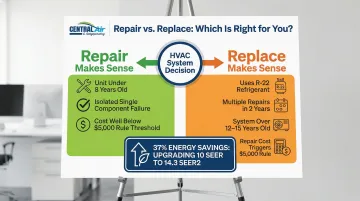
The $5,000 rule is a widely used industry benchmark: multiply your system's age (in years) by the estimated repair cost. If the result exceeds $5,000, replacement is the smarter financial call.
Example: A 12-year-old unit needing a $600 repair: 12 × $600 = $7,200. This exceeds the $5,000 threshold, making replacement the better long-term investment.
Additional Signals That Favor Replacement
- Uses R-22 refrigerant, which is costly and no longer manufactured
- Has needed repairs twice or more in the past two years
- Is more than 12–15 years old
- Runs below modern efficiency standards (Texas now requires a minimum 14.3 SEER2 for new systems)
With Texas residential electricity averaging around 14.68 cents per kWh, upgrading from an old 10 SEER unit to a compliant 14.3 SEER2 system can reduce cooling energy use by approximately 37%.
When Repair Clearly Wins
- Unit is under 8 years old
- Repair is a single isolated component
- Cost is well below the $5,000 rule threshold
- System is otherwise well-maintained
A proper diagnostic from a licensed technician is what turns this decision from a coin flip into a confident one.
What Most Homeowners Get Wrong About AC Repair Costs
A few common missteps can turn a manageable repair bill into a much bigger expense. Here's where homeowners in Bryan-College Station most often go wrong:
Focusing only on the upfront quote. An old, inefficient system that gets repaired will still cost more in monthly energy bills than a newer replacement. Think total cost of ownership—not just today's invoice. A $1,500 repair on a 14-year-old, 10 SEER unit can run you an extra $50–$80 per month in electricity compared to a new 16 SEER2 system.
Delaying repairs to save money. Small issues—a failing capacitor, a slow refrigerant leak—quickly escalate into compressor damage or full system failure. Bryan-College Station's summer heat accelerates this timeline fast. A $200 repair can become a $2,000+ problem within weeks when your system runs 12+ hours daily in 95°F heat.
Choosing based on price alone. The lowest quote isn't always accurate. Working with an established local company like Central Air & Refrigeration—with 10+ years of experience serving Bryan, TX and over 60 five-star reviews—means you get an honest diagnosis, not an upsell. Their certified technicians apply diagnostic fees toward repair costs when you move forward with service.
Frequently Asked Questions
How much does it cost to fix my AC unit?
Costs range from around $100 for simple fixes like capacitor replacements to $2,500+ for major repairs like compressor replacement. The exact cost depends on the type of repair, parts needed, and local labor rates in Bryan-College Station.
How much does an AC diagnostic test cost?
Diagnostic fees typically range from $79 to $129 in the Bryan-College Station area. Many HVAC companies apply this fee toward the repair cost if you book the repair.
Do HVAC companies do free diagnostics?
Some companies offer free or waived diagnostic fees as a promotional offer, but this isn't universal. Ask upfront whether the fee is waived only if you book the repair with them.
Is it cheaper to repair or replace an AC?
Repairs are typically cheaper in the short term for newer systems with isolated issues. For older units or expensive repairs, replacement often saves more money over time through lower energy bills and fewer future breakdowns.
What is the $5000 rule for AC?
Multiply your system's age by the estimated repair cost. If the result exceeds $5,000, replacement usually makes more financial sense. For example, a 10-year-old system needing a $600 repair (10 × $600 = $6,000) should likely be replaced.
What is the most expensive repair on an AC unit?
Compressor replacement is typically the most expensive AC repair, ranging from $2,200 to $4,800 depending on unit size and refrigerant type. In Bryan-College Station, older systems running on R-22 refrigerant face even higher costs, making full replacement the smarter call in most cases.