Introduction
Picture this: it's mid-August in Bryan-College Station, the temperature has climbed past 95°F, and your air conditioner quits. You're now facing a decision that could cost anywhere from $5,000 to $15,000—with no clear idea what's fair, what's excessive, or what you can safely cut.
Since 2020, HVAC equipment prices have jumped roughly 40%, with total system replacement costs nearly doubling due to supply chain disruptions and new refrigerant regulations.
The shift from R-410A to A2L refrigerant alternatives—mandated by the American Innovation and Manufacturing Act—has quadrupled refrigerant costs and forced manufacturers to redesign equipment entirely.
Replacement costs vary widely based on system type, home size, efficiency rating, and local labor rates. This guide breaks down real price ranges for Bryan-College Station, explains what drives costs up or down, and shows you how to avoid overpaying while getting a system that fits your home's needs.
Key Takeaways
- Typical replacement in Bryan-College Station runs $5,000 to $12,000+ depending on system type and home size
- Biggest cost drivers: system type (split AC, heat pump, package unit), SEER2 rating, and square footage
- Budget systems save upfront but cost more to run—BCS's six months of heavy AC use makes efficiency differences add up fast
- Local BTU rebates (up to $600) plus federal tax credits (up to $2,000 for heat pumps) can cut net costs significantly
- Right-sizing matters more in BCS than milder climates; undersized systems wear out faster and drive up utility bills
How Much Does HVAC Replacement Cost in Bryan-College Station, TX?
There is no single price for HVAC replacement. The "average" figures you'll find online—often $7,000 or $8,500—rarely account for Bryan-College Station's specific conditions: humidity that regularly exceeds 70% through summer, a cooling season that runs May through September with average August highs of 96.2°F, and local labor rates that differ from Houston or Austin.
Underbudgeting (accepting the first low quote without understanding what's included) or overbudgeting (assuming the highest estimate is standard) are both common mistakes. The three tiers below reflect what BCS homeowners actually pay — and what each level gets you.
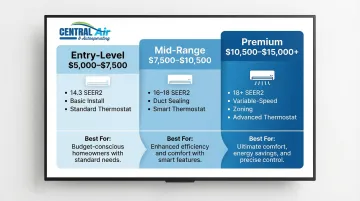
Three Pricing Tiers for Bryan-College Station
Entry-Level / Basic Replacement: $5,000–$7,500
- Standard SEER2-compliant central AC or package unit (14.3 SEER2 minimum)
- Basic installation with minimal ductwork modification
- Standard programmable thermostat
- Best for: Rental properties, tight budgets, homes with ductwork in good condition
Mid-Range / Standard Replacement: $7,500–$10,500
- Higher-efficiency unit (16–18 SEER2)
- Duct sealing or minor repairs included
- Programmable or basic smart thermostat
- Best for: Most BCS homeowners replacing a 10–15 year-old system
High-End / Premium Replacement: $10,500–$15,000+
- Two-stage or variable-speed system (18+ SEER2)
- Possible duct replacement or zoning additions
- Advanced smart thermostat with remote control
- Best for: Larger homes (2,500+ sq ft), homeowners prioritizing lower utility bills, or those planning to stay long-term
What's Included vs. What Costs Extra
Typically included in base quotes:
- New equipment (condenser, air handler, or package unit)
- Standard installation labor
- Refrigerant charging and system testing
- Basic startup and commissioning
Often billed separately:
- Electrical panel upgrades (if current service is insufficient)
- Duct repair or replacement
- Permit fees ($100–$500 in Brazos County)
- Haul-away and disposal of old equipment
- Extended warranties or maintenance plans
Always ask contractors to itemize quotes so you can compare line by line — a $500 difference between two bids often disappears once add-ons are visible.
The Bryan-College Station Reality
Saving $1,000 upfront by undersizing a system usually costs more within two to three years. An undersized unit runs near-constantly through the long BCS summer, never fully controls humidity, and wears out ahead of schedule — pushing utility bills higher the entire time. Proper sizing is the single most important factor in whether a new system performs as advertised.
Key Factors That Affect Your HVAC Replacement Cost
Five core factors determine what you'll actually pay in Bryan-College Station. The equipment is only part of the picture.
System Type and Configuration
The most common residential systems in Central Texas are:
- Central split systems (separate indoor air handler and outdoor condenser)—most common, widest range of efficiency options
- Package units (all-in-one outdoor unit)—common in slab-on-grade homes (homes with no crawl space or basement), often slightly lower cost
- Heat pumps (provide both heating and cooling)—higher upfront cost but lower heating bills in BCS's mild winters; eligible for larger federal tax credits
Heat pumps may cost $500–$1,500 more upfront than cooling-only AC, but the federal tax credit offers up to $2,000 for heat pumps vs. just $600 for standard AC, effectively narrowing the price gap.
System Size (Tonnage) and Home Square Footage
HVAC systems are sized in tons of cooling capacity. Choosing the wrong size—whether by guessing or skipping a proper Manual J load calculation—is a costly mistake.
Rough sizing guide for BCS:
- 1 ton per ~500–600 sq ft (starting rule of thumb)
- Most 1,500–2,500 sq ft BCS homes need 3–5 ton units
- Humidity, ceiling height, insulation, and window area affect this significantly
A proper load calculation accounts for your home's specific characteristics—size, layout, insulation, and window exposure. Getting sizing right up front prevents short-cycling, uneven cooling, and premature equipment failure.
SEER2 Efficiency Rating
Higher SEER2 ratings cost more upfront but reduce monthly utility bills—particularly important in BCS where AC runs heavily 6+ months annually.
Federal minimums (effective Jan 1, 2023):
- Split-system AC (<45,000 Btu/h): 14.3 SEER2 minimum
- Heat pumps: 14.3 SEER2 and 7.5 HSPF2 minimum
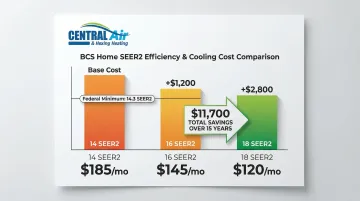
Going above minimum often pays off. Upgrading to newer efficiency standards delivers energy cost savings of approximately 5.5% to 9.7% depending on climate zone. In BCS's demanding climate, a 16 or 18 SEER2 system can cut summer utility bills by $30–$60/month compared to a 14 SEER2 unit—savings that add up over a 15-year lifespan.
Ductwork Condition
If existing ductwork is leaking, undersized, or deteriorated, repair or replacement can add $1,000–$4,000+ to total project cost.
The problem is widespread: leaky ducts in average Texas homes allow more than 30% of cooling energy to escape. Code now mandates strict testing, with leakage rates not exceeding 4 CFM per 100 sq. ft. of conditioned floor space.
Ductwork costs in Texas:
- Professional duct sealing: $500–$2,000
- Full duct replacement: averages $1,485, with typical range of $658–$2,496
Many older BCS homes have ductwork issues that only surface during a replacement quote—a frequent reason quotes come in higher than expected.
Labor, Permits, and Local Market Conditions
Bryan-College Station labor rates differ from Houston or Austin. HVAC technicians in the College Station-Bryan area earn a mean hourly wage of approximately $21.17, though billed rates are higher to cover overhead, insurance, and profit (typically $75–$150/hour).
Permits are required for HVAC replacement in Brazos County and typically add $100–$500 to the total. Choosing a licensed local contractor with itemized, transparent quotes reduces the risk of hidden fees. Central Air & Refrigeration provides written estimates broken down by equipment, labor, and permit costs. Call (979) 324-6791 for a free estimate.
What Your HVAC Replacement Quote Actually Covers
A legitimate HVAC replacement quote should be fully itemized — no lump sums, no vague "labor and materials" lines. When you're comparing quotes in Bryan-College Station, here's what each one should break out clearly:
Equipment cost (50–60% of total project cost)
- The unit itself—condenser, air handler, or package system
- Typically the largest single line item
Installation labor
- Removal of old unit and safe disposal
- Installation of new equipment
- Refrigerant charging and leak testing
- System commissioning and performance verification
Permits and inspection fees
- Required in most Texas jurisdictions for full system replacement
- Ensures code compliance and safety
What's Usually NOT Included
Ask about these separately before signing:
- Electrical panel upgrades (if your home's service is insufficient for the new unit)
- Duct repair or replacement
- Thermostat upgrades (especially smart thermostats)
- Extended warranties or maintenance plans
Before you sign anything, get clarity on every line — surprises on these items can add hundreds to your final bill. Central Air & Refrigeration breaks down every cost upfront, so there are no unexpected charges after the job starts. Call (979) 324-6791 to request a detailed estimate.
Budget vs. Premium Systems: What's the Real Difference?
Both a $5,500 system and a $12,000 system will cool your Bryan-College Station home. The question is how well, for how long, and at what ongoing cost.
Performance and Comfort
Budget single-stage systems:
- Run at 100% capacity whenever on
- Cycle on/off frequently, creating temperature swings
- Struggle with humidity removal in BCS's humid summers—units cool air quickly but shut off before effectively dehumidifying, leaving homes cold but clammy
Premium two-stage or variable-speed systems:
- Modulate output (can run as low as 40% capacity)
- Maintain steadier temperatures with fewer cycles
- Run longer at lower speeds, continuously removing humidity without overcooling
In Bryan-College Station's humid climate, humidity control matters just as much as temperature. That's where premium systems earn their price tag.
Lifespan and Reliability
Standard AC units typically last 10–15 years. In BCS's demanding climate, a budget system running at maximum capacity all summer tends to wear out faster. Premium systems that avoid the stress of constant on/off cycling may offer better longevity, though proper maintenance still matters more than equipment tier alone.
Long-Term Operating Cost
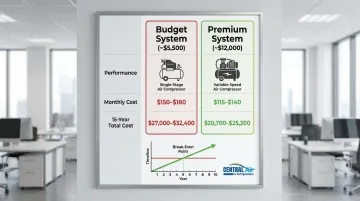
Efficiency differences compound over time. A typical 2,000 sq ft BCS home running a 14 SEER2 system might spend $150–$180/month on cooling during peak summer. An 18 SEER2 system could cut that to $115–$140/month—a savings of $35–$40/month or $420–$480/year.
Over 15 years, that's $6,300–$7,200 in savings. A premium system that costs $3,000 more upfront can pay for itself—and keep saving money well past that break-even point.
How to Budget Smartly for HVAC Replacement in Bryan-College Station
Before accepting any quote, get clear answers on these key questions:
- How old is the current system, and what condition is the ductwork in?
- Has the contractor performed a proper load calculation (Manual J)?
- What SEER2 level makes financial sense given how long you plan to stay?
- Will higher efficiency pay back within your ownership timeline?
- Are there utility rebates or tax credits that apply to the system you're considering?
Available Incentives for Bryan-College Station Homeowners
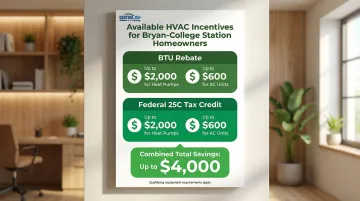
Bryan Texas Utilities (BTU) Rebates:
- Central AC: up to $600 for qualifying high-efficiency units
- Heat pumps: up to $2,000 for air source and geothermal systems
Federal Energy Efficient Home Improvement Tax Credit (25C):
- Heat pumps: 30% of cost, up to $2,000 per year
- Central AC: 30% of cost, up to $600 per year
- Equipment must meet the highest efficiency tier established by the Consortium for Energy Efficiency
Potential savings stack: A qualifying high-efficiency heat pump could net you $2,000 (BTU) + $2,000 (federal) = $4,000 in combined incentives—enough to move a $12,000 system down to $8,000 net cost.
Stacking these incentives takes some coordination — not every system qualifies, and BTU rebates require specific paperwork. Central Air & Refrigeration has navigated this process for BCS homeowners for over 10 years and can confirm which incentives apply before you commit to a system. Call (979) 324-6791 to schedule a consultation.
Frequently Asked Questions
How much does it cost to replace an HVAC system in Bryan, TX?
Most Bryan homeowners pay between $5,000 and $12,000+ depending on system type, size, and efficiency rating. Mid-range replacements for a typical 2,000 sq ft home run $7,500–$10,500 installed, with premium systems exceeding this range.
How much does a new HVAC system cost for a 2,000 sq ft house in Bryan, TX?
A 2,000 sq ft home in BCS typically needs a 3–4 ton system. The right size depends on insulation quality, ceiling height, and sun exposure — an oversized unit short-cycles and wears out faster, while an undersized one runs constantly. A Manual J load calculation from your contractor confirms the correct tonnage before installation.
How much does a new AC unit cost for a 1,500 sq ft house in Bryan, TX?
A 2.5–3 ton central AC unit for a 1,500 sq ft home in Bryan generally costs $5,500–$8,500 installed, depending on brand, SEER2 rating, and ductwork condition.
What is the $5,000 rule for HVAC?
The $5,000 rule helps decide repair vs. replacement: multiply the repair cost by the system's age in years. If the result exceeds $5,000, replacement is usually the smarter financial move. Example: a 12-year-old unit needing a $600 repair (12 × $600 = $7,200) is a candidate for replacement.
What programs or incentives help pay for HVAC replacement in Bryan, TX?
Two programs can offset your replacement cost:
- Bryan Texas Utilities rebates: up to $600 for qualifying AC units, up to $2,000 for heat pumps
- Federal 25C tax credit: up to $600 for high-efficiency AC, up to $2,000 for heat pumps on qualifying equipment
Is it worth replacing a 30-year-old furnace?
Yes. A 30-year-old furnace is well past its typical 15–20 year lifespan, is far less efficient than modern units, and replacement makes financial and safety sense at that age.