
Introduction
When a heating system fails in Bryan, TX, homeowners face a real choice: stick with a gas furnace at a lower upfront cost, or switch to a heat pump built for year-round efficiency? It's not a simple swap. Central Texas winters stay mild most of the year, but deep freezes like Winter Storm Uri can test any system's limits fast.
The answer depends on Texas's distinct climate profile. Four factors shape the math here:
- Warm weather 9+ months of the year
- Rare but severe hard freezes
- Electricity rates around $0.116/kWh
- Natural gas access at roughly $1.10–$1.20 per therm
These variables determine which system saves more in practice — not just on paper.
This guide breaks down both systems side by side, covering upfront costs, operating expenses, and lifespan, then delivers a Texas-specific verdict so Bryan-area homeowners know exactly which system makes financial sense for their situation.
Key Takeaways
- Heat pumps transfer heat from outdoor air and double as cooling systems, making them a strong fit for Texas's long warm seasons and mild winters
- Gas furnaces deliver powerful, fast heat using natural gas, which makes them cost-effective when gas lines are already in place and useful during rare hard freezes
- In Texas's climate, heat pumps typically win on annual operating costs due to 300–400% efficiency during 9+ months of mild weather
- Federal tax credits (30% up to $2,000) and potential HOMES rebates (up to $8,000) significantly offset heat pump costs
- The right choice depends on existing infrastructure, insulation quality, energy rates, and actual heating needs
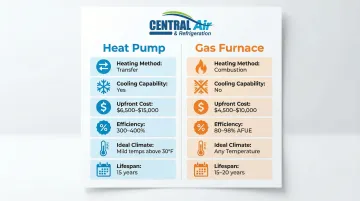
Heat Pump vs. Furnace: At a Glance
| Feature | Heat Pump | Gas Furnace |
|---|---|---|
| Heating Method | Transfers heat from outdoor air using refrigerant | Burns natural gas in combustion chamber |
| Cooling Capability | Yes—doubles as central AC | No—requires separate AC unit |
| Upfront Cost | $6,500–$15,000 installed | $4,500–$10,000 installed |
| Operating Efficiency | 300–400% (COP 3.0–4.0) in mild temps | 80–98% AFUE |
| Ideal Climate | Temperatures above 25–30°F | Any temperature, especially extreme cold |
| Average Lifespan | 15 years | 15–20 years |
Heat Pump Snapshot
- Electric-powered systems that move heat rather than generate it
- Deliver 3–4 units of heat per unit of electricity—far more efficient than resistance heating
- Double as your central AC, eliminating the need for a separate cooling system
- Well-suited to Bryan winters, where temps rarely dip below freezing for long
Gas Furnace Snapshot
- Burns natural gas to deliver high-output heat fast, with air temps reaching 140–170°F
- Operates reliably in any temperature, including rare hard freezes
- Requires a separate AC unit for summer cooling
- Lower upfront installation costs, particularly when gas lines and ductwork already exist
What is a Heat Pump? How It Works in Texas Weather
A heat pump uses refrigerant to extract heat energy from outdoor air—even when it feels cold outside—and moves it inside. Think of it as an air conditioner running in reverse. The system outputs warm air at 90–110°F, lower than a furnace but sustained efficiently over longer run cycles.
Bryan and Central Texas winters rarely sustain temperatures below 25–30°F, meaning heat pumps operate near peak efficiency for the vast majority of heating days. Unlike Northern states where efficiency drops significantly in prolonged cold, Texas conditions play to the heat pump's strengths.
A heat pump replaces both your furnace and your AC in one unit. For homeowners replacing aging equipment, that means one installation cost, one service contract, and one piece of equipment to maintain.
The honest limitation: During rare hard freezes like Winter Storm Uri, standard air-source heat pumps become less efficient and may rely on electric resistance backup heating, which can spike electricity bills temporarily.
Benefits for Texas Homeowners
Texas has more heat pumps installed in homes than any other state. According to the Energy Information Administration's 2020 survey, approximately 1.95 million Texas households use heat pumps. That scale means local service technicians are familiar with the equipment, parts are widely available, and installation contractors throughout Bryan have hands-on experience with these systems.
Beyond the numbers, heat pumps offer day-to-day comfort advantages that matter in Bryan's climate:
- Humidity balance: Unlike gas furnaces that dry the air during combustion, heat pumps circulate naturally humid air
- Year-round use: The same unit handles both heating and cooling, reducing total equipment costs
- Quieter operation: Modern heat pumps run at variable speeds, avoiding the sudden blasts of a furnace cycling on
- No combustion byproducts: No gas combustion means no carbon monoxide risk and cleaner indoor air
What is a Gas Furnace? Reliability When It Counts
A gas furnace burns natural gas in a combustion chamber, passing hot flue gases (around 250°F) through a heat exchanger while a blower pushes household air past it. Output air temperatures reach 140–170°F, making it the fastest system for heating a cold home quickly.
In Texas, a gas furnace proves most valuable during the 5–15 days per year when Bryan temperatures drop below freezing. If your home already has a gas line and ductwork, a furnace replacement is simple and often costs less upfront than a full heat pump system.
When a Gas Furnace Makes Sense
A furnace is the right fit for:
- Existing gas lines and ductwork already in place — no costly infrastructure upgrades needed
- Older, poorly insulated homes where a heat pump's lower-output air can't keep up with heat loss
- Households that need near-instant warmth during cold snaps
- Replacing only the heating system while keeping a functioning central AC unit
If you want efficiency without sacrificing cold-weather performance, a dual-fuel hybrid system bridges that gap: a heat pump handles everyday heating while a gas furnace kicks in during extreme cold. This premium option costs more upfront ($7,000–$15,000) but eliminates the efficiency-versus-reliability trade-off entirely.
Cost Breakdown: Installation, Operating Costs, and Lifespan
Upfront Installation Costs
Installation costs vary significantly based on home size, existing infrastructure, and equipment efficiency:
- Gas Furnace Replacement: $4,500–$10,000 (assumes existing gas lines and ductwork)
- Air-Source Heat Pump: $6,500–$15,000 (includes full system; higher range for variable-speed models)
- Dual-Fuel Hybrid System: $7,000–$15,000 (combines heat pump + gas furnace)
Hidden cost warning: Homes built before 2000 often require electrical panel upgrades to handle heat pump loads, adding $1,500–$3,000 to the project cost.
Operating Cost Comparison
The efficiency math reveals why heat pumps often win in Texas:
- Heat pump: Operates at 300–400% efficiency (COP 3.0–4.0) in mild Texas winters — delivering 3–4 units of heat per unit of electricity at Bryan's $0.116/kWh rate
- Standard gas furnace: 80% AFUE (20% of energy lost up the flue); high-efficiency models reach 90–98% AFUE
- Natural gas cost: $1.10–$1.20/therm is cheaper per unit than electricity, but furnaces can't match heat pump efficiency multipliers
The crossover point: While gas costs less per unit of energy, heat pumps move 3–4 times more heat per unit of electricity than furnaces generate per unit of gas. In Bryan's mild climate, this efficiency advantage means heat pumps typically cost less to operate annually.
Annual Savings Potential
Replacing a gas furnace and separate AC with a high-efficiency heat pump can save $300–$500 annually on combined heating and cooling costs in mild climates. The American Council for an Energy-Efficient Economy (ACEEE) found a return on investment of nearly 49% for heat pump upgrades in Texas over the equipment's life, driven by cooling efficiency gains and reduced winter energy use.

Lifespan and Maintenance Costs
Heat pumps typically last 15 years. Since they replace both heating and AC, you're comparing the cost of one system against two — which changes the math on total ownership cost.
Gas furnaces last 15–20 years but carry recurring maintenance requirements:
- Annual gas line inspections
- Heat exchanger checks
- Carbon monoxide safety checks
- Combustion analysis
These add up over 15–20 years — and before factoring in any available incentives that can offset upfront heat pump costs.
Rebates and Incentives Available in Texas
Federal Tax Credits (IRA Section 25C): Homeowners who install a qualifying high-efficiency heat pump can claim a federal tax credit of 30% of the cost, up to $2,000 per year through December 31, 2032. Equipment must meet the highest efficiency tier established by the Consortium for Energy Efficiency.
HOMES Rebate Program: The state-administered HOMES rebate offers up to $8,000 for qualifying heat pump installations based on income. As of early 2026, Texas has received federal funding allocation, but the program launch by the State Energy Conservation Office (SECO) is still pending. Homeowners should monitor SECO announcements for application opening dates.
Which Heating System Saves You More Money in Texas?
The answer depends on five key variables specific to your Bryan home:
- Existing infrastructure (gas line + ductwork vs. electric-only)
- Home insulation quality
- Local electricity vs. gas rates
- Frequency of extreme cold events
- Whether you need a new AC anyway
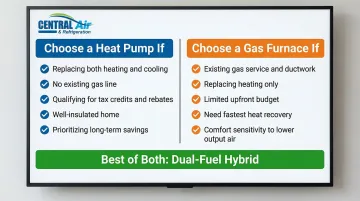
Choose a Heat Pump If:
- Your home needs both new heating AND cooling systems
- You have no existing gas line
- You want to take advantage of federal tax credits and rebates
- Your home is well-insulated
- You prioritize long-term operating cost savings
In Bryan's mild climate, the heat pump's efficiency advantage during the long warm season typically wins on total annual cost when you factor in dual heating/cooling function.
Choose a Gas Furnace If:
- Your home already has gas service and ductwork
- You're only replacing the heating system (keeping existing AC)
- Upfront budget is limited
- You experience specific medical/comfort sensitivity to gentler heat output
- You prioritize the fastest heat recovery during cold snaps
Local Expertise Matters
For Bryan homeowners who want a personalized cost comparison, the numbers look different depending on your home's actual specs: square footage, insulation quality, existing equipment, and current utility rates. A proper assessment beats any rule of thumb.
Central Air & Refrigeration has served the Bryan, TX area for 10+ years and can walk you through a side-by-side cost analysis for your specific home. Reach them Monday–Friday, 8AM–6PM at (979) 324-6791.
The Verdict
In most Texas homes—especially those needing full HVAC replacement—a heat pump delivers better long-term value when rebates and dual heating/cooling function are factored in. The 300–400% efficiency during Bryan's dominant mild weather outweighs the occasional efficiency drop during rare freezes.
The furnace remains the stronger choice in specific scenarios, particularly for homes with existing gas infrastructure that are replacing only the heating component. A hybrid system eliminates the trade-off entirely for homeowners who want peak efficiency without sacrificing performance during a hard freeze.
Frequently Asked Questions
Is a heat pump worth it in Texas?
For most Texas homeowners, yes. Heat pumps run at high efficiency through the mild winters here and handle cooling too, eliminating a separate AC. The federal IRA tax credit (30%, up to $2,000) makes the upfront cost even easier to justify.
Which heating system is the most cost-effective?
Heat pumps typically win on annual operating cost in Texas due to their 300–400% efficiency vs. a furnace's 80–98%. However, upfront installation cost and existing home infrastructure—especially a gas line—can tip the balance toward a gas furnace for some homeowners.
How much does it cost to install a heat pump in a 2000 sq ft house?
For a typical 2,000 sq ft home in Texas, expect $6,800–$14,800 installed. Final price varies based on system size (tonnage), brand, any needed electrical panel upgrades, and local labor rates. A local HVAC contractor can give you a precise number based on your home's setup.
Why is my electric bill so high with a heat pump?
Two common causes:
- Backup electric resistance heat kicking in during unusually cold snaps (far less efficient than standard heat pump operation)
- Poor insulation forcing the system to run longer to hold the set temperature
What is the heat pump rebate in Texas?
The federal IRA Section 25C credit covers 30% of installation costs, up to $2,000. A state HOMES rebate of up to $8,000 is also available based on income, though Texas program availability was still pending as of early 2026.
Do Texans have furnaces?
Yes — gas furnaces are common across North Texas and anywhere with natural gas infrastructure. That said, Texas leads the nation in heat pump installations, with nearly 2 million homes using them thanks to the state's mild winters and long cooling season.