Introduction
It's peak summer in Bryan-College Station, temperatures are pushing past 100°F, and your AC goes out. The contractor you call next can mean the difference between a fast, affordable fix and an overpriced, poorly done job.
Hiring an unqualified or unreliable HVAC contractor can lead to improper installation, voided warranties, safety hazards, and higher long-term costs. In a region that experiences 71 days annually above 90°F and 12 days above 100°F, the stakes are real.
This guide walks you through exactly what to check before signing any agreement.
Key Takeaways
- Texas law requires HVAC contractors to hold a valid TDLR license — always verify before hiring
- Get 2-3 written, itemized estimates and confirm proof of insurance and bonding
- Bryan-College Station's hot-humid climate requires contractors familiar with proper system sizing for local conditions
- Prioritize NATE and EPA 608 certifications alongside the required state license
- Central Air & Refrigeration brings 10+ years of Bryan-area experience, certified techs, and 24/7 emergency response
Why the Right HVAC Contractor Choice Matters in Bryan-College Station
Bryan-College Station sits in ASHRAE Climate Zone 2A (hot-humid), where long, intensely hot summers with high humidity put extreme stress on HVAC systems. Equipment in this climate runs longer and harder than in most U.S. regions — a poorly installed or serviced system can add hundreds of dollars annually to energy bills while cutting years off its lifespan.
In a college town with a mix of rental properties, residential homes, restaurants, and commercial spaces, the quality of HVAC work directly impacts:
- Energy bills
- Indoor air quality
- Equipment lifespan
- Comfort and safety during extreme heat
All of that rides on who does the work. Dozens of contractors operate in the BCS area, but not all hold the required Texas licenses or carry adequate insurance. Knowing what to check before signing any agreement protects you from liability, poor workmanship, and avoidable expense.
7 Things to Check When Hiring an HVAC Contractor in Bryan-College Station, TX
Before you hire anyone, run through this checklist. It covers the seven factors that separate reliable HVAC contractors from ones that will cost you more in the long run.
Check #1: Valid Texas HVAC License
In Texas, all HVAC contractors must hold a license issued by the Texas Department of Licensing and Regulation (TDLR). Operating without one is illegal and leaves you exposed to liability.
How to verify a license:
- Visit the TDLR license lookup tool
- Search by contractor name or license number
- Confirm the license is active and covers the type of work requested
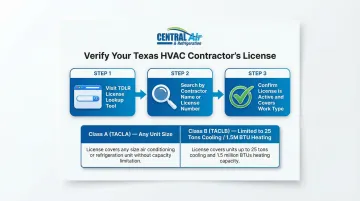
License types:
- Class A (TACLA): Work on units of any size
- Class B (TACLB): Limited to cooling systems of 25 tons and under, heating systems of 1.5 million BTUs/hour and under
Why it matters: A company that does not employ a license holder at the time a contract is signed may not collect a fee or enforce the contract. Unlicensed work also means no recourse if something goes wrong.
Check #2: Proof of Insurance and Bonding
General liability insurance and workers' compensation coverage are essential. If a technician is injured on your property or causes damage without coverage, you could be held financially responsible.
Texas insurance requirements:
| License Class | Per Occurrence | Aggregate |
|---|---|---|
| Class A | $300,000 | $600,000 |
| Class B | $100,000 | $200,000 |
What to request:
- Certificate of Insurance (COI)
- Confirmation of workers' compensation coverage
- Bonding information (adds financial protection against incomplete or faulty work)
If a contractor hesitates or can't produce these documents on request, treat it as a disqualifying sign — not a minor inconvenience.
Check #3: Local Experience in the Bryan-College Station Climate
HVAC contractors with experience specifically in BCS and the Brazos Valley understand the load calculation requirements for Texas' hot-humid climate zone. Proper system sizing based on local conditions prevents:
- Oversizing: Causes humidity problems, short cycling, and reduced moisture removal
- Undersizing: Leads to constant runtime and early failure
Research shows that systems oversized by just 20% achieve only 15% latent heat removal (moisture control) under part-load conditions, compared to 30% for correctly sized systems.
Sizing is only part of it. Local experience also means the contractor accounts for conditions that standard calculations often miss:
- High attic temperatures that stress equipment year-round
- Ductwork heat gain in unconditioned spaces
- Equipment wear from long cooling seasons that can stretch eight months or more
Check #4: Industry Certifications and Technical Qualifications
Beyond the state license, certifications signal that a technician has passed independent, third-party exams validating their technical knowledge.
Key certifications to look for:
NATE (North American Technician Excellence) validates real-world working knowledge through a Core exam plus a Specialty exam, with recertification every two years. It's the most recognized third-party credential in the industry.
EPA Section 608 Certification is federally required for any technician who handles refrigerants. Its absence isn't a minor gap — it's a legal violation. Look for Type II (high-pressure/residential AC) or Universal certification for standard residential and commercial work.
Check #5: Verified Reviews and Local Reputation
Google reviews, Yelp, and Nextdoor are the most reliable sources for vetting local HVAC contractors. 87% of consumers use Google to evaluate local businesses, and 38% require a minimum 4-star rating before considering a service provider.
What to look for:
- Patterns in reviews (recurring praise or complaints)
- How the company responds to negative feedback
- Consistency across multiple platforms
- Specific details in reviews (not just generic praise)
Ask neighbors, friends, or colleagues in the Bryan-College Station community for referrals. Word-of-mouth in a relatively tight-knit community like BCS tends to be reliable — and locals will tell you things that don't show up in online reviews.
Check #6: Transparent Pricing and Written Estimates
Any legitimate HVAC contractor should provide a written, itemized estimate before work begins. This should include:
- Equipment costs
- Labor charges
- Permits
- Removal/disposal fees
Warning signs:
- Vague verbal quotes
- Unusually low bids (often indicate substandard equipment, unlicensed labor, or hidden fees)
- Pressure to sign immediately without time to review
Get at least 2-3 quotes for comparison. The average cost to install a new AC unit ranges from $3,911 to $8,066. Full system replacement (AC + furnace) typically runs $3,300 to $16,000 for equipment, plus roughly $1,500 for labor.
Check #7: Availability and Emergency Response Time
In Bryan-College Station's summers, an HVAC breakdown is a health risk . Studies show that lack of air conditioning is associated with a 15.1% increase in mortality risk on extreme heat days, with elderly residents, young children, and those with medical conditions being most vulnerable.
What to ask:
- Do they offer 24/7 emergency service?
- What is their average response window for emergency calls?
- Do they keep common parts in stock to avoid multi-day delays?
In a climate where summer temperatures regularly exceed 100°F, same-day emergency availability should be a baseline expectation — not a premium add-on. Central Air & Refrigeration, for example, offers 24/7 emergency service in Bryan-College Station precisely because a one-day delay in this heat can turn an uncomfortable situation into a dangerous one.
Red Flags That Should Make You Walk Away
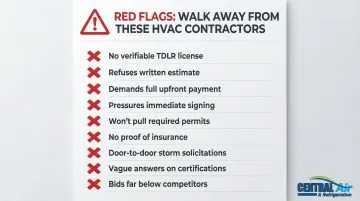
Some contractors make it easy to spot trouble early. Before you sign anything, watch for these warning signs:
- No verifiable TDLR license number
- Refusal to provide a written estimate
- Requesting full payment upfront before any work begins
- Pressure to sign immediately without time to review the quote
- Cannot or will not pull required permits for installation or replacement work
- No proof of insurance or workers' compensation coverage
- Door-to-door solicitations right after storms or extreme weather events
- Vague answers about certifications or prior experience
- Bids significantly lower than competitors with no clear explanation
In Texas, unpermitted HVAC work can void your homeowner's insurance coverage, complicate a home sale, and leave you liable for code violations — so any contractor unwilling to pull permits is a contractor worth skipping.
Why Central Air & Refrigeration Checks Every Box in Bryan-College Station
Central Air & Refrigeration is a locally rooted HVAC contractor serving Bryan-College Station with over 10 years of hands-on experience in the region's specific climate demands. Unlike franchises or out-of-area companies, this is a team built around the heat, humidity, and seasonal swings of the Brazos Valley.
Here's how they measure up against the checklist in this guide:
- Licensed, certified technicians with verified HVAC credentials
- Transparent, upfront pricing with no hidden fees
- Fast response times and emergency repair services
- 5-star Google rating backed by 63 verified customer reviews
- Trusted by 1,500+ customers across homes, businesses, restaurants, and commercial properties
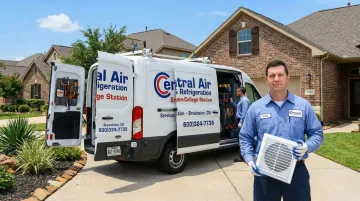
Their service coverage spans every system type a Bryan-College Station property owner is likely to need.
Services include:
- Central air conditioning systems
- Heat pumps and ductless mini-splits
- Furnaces and packaged HVAC systems
- Commercial refrigeration for restaurants, grocery stores, and medical facilities
- Emergency repairs and maintenance programs
Central Air & Refrigeration offers free, no-obligation estimates and maintains a policy of upfront, honest quotes that fit your budget. Their service vehicles are fully equipped with common parts, allowing technicians to complete most repairs on-site without delays.
Call Central Air & Refrigeration at (979) 324-6791 or email centralaaservice@gmail.com to get a no-pressure estimate from a contractor that already meets every standard outlined in this guide.
Conclusion
In Bryan-College Station's climate, the HVAC contractor you hire directly affects your comfort, energy bills, and the lifespan of a system that can cost thousands to replace. Getting this decision right matters.
Use the 7-point checklist every time, whether it's for a repair, a new installation, or a routine tune-up. A contractor worth hiring — like the team at Central Air & Refrigeration, serving Bryan-College Station for over a decade — will welcome every question and clear every check without hesitation.
Frequently Asked Questions
How much does it cost to replace an HVAC system in Texas?
HVAC replacement in Texas typically runs $3,300–$16,000 for equipment, plus around $1,500 for labor. Final cost depends on system size, home square footage, SEER rating, and local labor rates. Always get multiple written estimates before committing.
What should I look for when choosing an HVAC contractor in Texas?
Look for these before hiring:
- Valid TDLR license and proof of insurance/bonding
- Relevant certifications (NATE, EPA 608)
- Local reviews with at least a 4-star rating
- Written, itemized estimate
- Familiarity with Texas climate demands and 24/7 emergency availability
Central Air & Refrigeration meets all of these standards and has served Bryan, TX homeowners and businesses for over a decade.
Do HVAC contractors need to be licensed in Texas?
Yes, Texas law requires HVAC contractors to be licensed through the Texas Department of Licensing and Regulation (TDLR). Hiring an unlicensed contractor can expose homeowners to legal and financial liability, and unlicensed contractors cannot legally enforce contracts or collect fees.
How do I look up or verify an HVAC contractor's license in Texas?
Visit the TDLR's online license search tool at tdlr.texas.gov/LicenseSearch. Search by company name, individual name, or license number to confirm the license is active, in good standing, and covers the type of work being requested.
What is the $5000 rule for HVAC?
The $5,000 rule suggests that if repair cost multiplied by the unit's age exceeds $5,000, replacement is more cost-effective than continued repair. For example, a 10-year-old unit with a $600 repair equals $6,000 — suggesting replacement over repair.
What is the highest rated HVAC brand?
Brands like Trane, Carrier, Lennox, and Rheem consistently rank highly for reliability, efficiency ratings, and warranty coverage. However, the quality of installation and the contractor's skill level matters just as much as the brand itself when it comes to long-term performance.