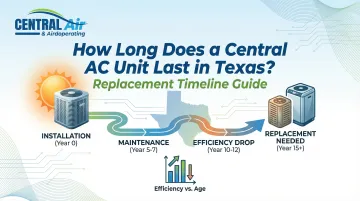
The core tension: replace too late and risk a breakdown in peak summer heat with expensive emergency costs; replace too early and leave real service life on the table. This guide covers realistic AC lifespan in Texas, the specific factors that accelerate wear in this climate, a year-by-year replacement decision framework, and the key warning signs that separate a repairable unit from one that needs to go.
Key Takeaways
- Most central AC units last 10–15 years in Texas, compared to 15–20 years in cooler climates, due to extended cooling seasons and intense heat load
- Long summers, high humidity, dust, and solar heat gain all accelerate wear on compressors, capacitors, and coils faster than in most other states
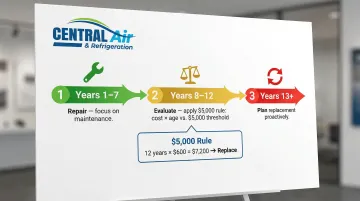
- Use a replacement timeline by system age: under 8 years (repair), 8–12 years (evaluate), 13+ years (plan to replace)
- Rising energy bills, frequent repairs, and uneven cooling signal repair costs are outpacing the value of keeping the unit
- The $5,000 rule (repair cost × system age) helps Bryan homeowners decide whether to repair or replace without second-guessing the numbers
How Long Does a Central AC Unit Last in Texas?
Nationally, a well-maintained central AC unit lasts 15–20 years, but in Texas, the realistic range is closer to 10–15 years — and in high-use climates like Bryan, some systems show significant decline by year 10–12.
Why Texas Compresses the Lifespan
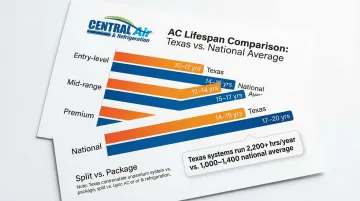
Unlike northern states where an AC might run 3–4 months per year, Texas homeowners often run their systems 6–8 months annually. A 10-year-old Texas unit may have accumulated the operating hours of a 15–18-year-old unit in a cooler state. Texas systems run approximately 2,200+ hours annually, compared to the national average of 1,000–1,400 hours.
Brand and unit type influence lifespan ranges:
- Entry-level systems: 10–12 years in Texas heat
- Mid-range systems: 12–14 years with proper maintenance
- Premium systems: 14–15 years, though rarely beyond that in Bryan's climate
- Package units vs. split systems: Split systems typically last 1–2 years longer due to protected indoor components
Where age and unit type set the baseline, refrigerant type often determines whether an older system is worth keeping at all.
The Refrigerant Factor
Systems manufactured before 2010 likely use R-22 (now banned and expensive to source), which means an older unit may have an accelerated economic lifespan even if mechanically functional. R-22 refrigerant costs $145–$195 per pound in 2025, making a typical recharge (6–12 lbs) cost $660–$2,400 — often exceeding the value of the aging unit itself.
That's why decisions about repair vs. replacement rarely hinge on age alone — operating hours, refrigerant type, and maintenance history all shape the real timeline.
Why Texas Climate Shortens AC Lifespan
AC lifespan comes down to runtime hours and thermal stress. The hotter and more humid the climate, the harder the compressor works on every cycle — and that accumulated strain accelerates wear on the unit's most expensive components.
How Bryan's Climate Accelerates AC Wear
Bryan/College Station sits in a zone with long, humid summers where heat index values frequently exceed comfortable ranges. This forces AC systems to run longer cycles to hit set temperatures. The region experiences roughly 2,756 cooling degree days compared to the national average of 1,215.
Bryan-specific stressors:
- 102 days per year with temperatures reaching 90°F or higher
- 54 days per year reaching 95°F or higher
- Extreme years (like 2011) recorded 152 days above 90°F
High outdoor humidity adds another layer of stress. The evaporator coil must remove moisture from the air before it can cool the space — increasing system load, reducing efficiency, and wearing down coil components faster than temperature alone would.
Climate stress only tells part of the story. How a system is sized and installed determines whether it can handle those conditions — or fails years ahead of schedule.
Sizing and Installation Problems That Cut Lifespan Short
Improper sizing is a common but overlooked cause of early AC failure in Texas:
- Oversized units short-cycle frequently, leading to excess compressor wear and potentially reducing equipment life by up to 50%
- Undersized units run near-continuously on hot days and never fully recover, causing overheating of electrical components and compressor failure
Poor ductwork — leaks, inadequate insulation, or improper design — forces the system to compensate for lost efficiency, adding cumulative operating hours that directly reduce lifespan. Central Air & Refrigeration addresses these issues through proper load calculations and ductwork inspections during replacement consultations.
Your AC Replacement Timeline Guide
Rather than giving a single number, here's what action to take based on your unit's age and current condition — giving Bryan homeowners a proactive plan rather than a reactive one.
Year 1–7: Focus on Maintenance, Not Replacement
Systems in this range should be performing reliably; issues in this window are almost always repair-worthy.
Normal service includes:
- Capacitor replacement ($50–$300)
- Refrigerant check and minor top-off
- Coil cleaning
- Contactor replacement
Red flags that indicate installation or manufacturing defects:
- Repeated failures of the same component
- Inability to maintain temperature from day one
- Refrigerant leaks within the first 3 years
Central Air & Refrigeration offers comprehensive maintenance plans with bi-annual visits (spring and fall) to catch these issues early and extend system life.
Year 8–12: Evaluate the Repair-vs-Replace Equation
This is the critical window in Texas. The $5,000 rule offers a reliable benchmark: multiply the estimated repair cost by the system's age in years — if the result exceeds $5,000, replacement is typically the better financial decision.
Example: A 12-year-old unit needing a $600 compressor repair:
- 12 years × $600 = $7,200
- Result: Replacement recommended
This matters especially if the system is showing efficiency losses or using R-22. At this stage, a professional evaluation from a local HVAC contractor — like Central Air & Refrigeration in Bryan — can assess actual system condition, refrigerant status, and whether a targeted repair extends useful life or simply delays an inevitable replacement.
Year 13 and Beyond: Plan a Proactive Replacement
Once you've crossed the replacement threshold, the question shifts from whether to replace to when. Systems in this range should be considered at end-of-life for planning purposes, even if still running.
The risk of reactive replacement:
- Emergency call in peak July heat
- Limited contractor availability
- Premium pricing (1.5x to 3x standard rates)
- No time to compare units or financing options
Modern SEER2-rated systems offer substantially better efficiency than units installed 13+ years ago. Upgrading from a base-level 13.4 SEER2 unit to a high-efficiency 20.0 SEER2 model can reduce annual cooling costs by approximately 27%.
The savings compound over time. A modern ENERGY STAR replacement for a 15-year-old system can cut total energy use by 20% to 40% — a meaningful return in a climate where your AC runs six or more months a year.
Warning Signs It's Time to Replace Your AC, Not Just Repair It
Not every AC problem means replacement — but some do. A failed capacitor on a 6-year-old unit is a straightforward repair. That same repair on a 13-year-old unit with two other issues this season is a different conversation entirely.
Five Clearest Replacement Indicators
1. Energy bills rising without changes in usage or weather
- Aging systems lose efficiency — by year 12, a unit may operate at 20–30% lower efficiency than when new
- A system rated at 13 SEER in 2012 may perform like a 9 SEER unit today, increasing electricity usage by 25–35%
2. Repairs two or more seasons in a row
- Compounding repair costs signal systemic decline
- If total repair costs this year and last exceed 50% of a new unit's price, replacement typically makes more financial sense
3. The system can't maintain set temperature on the hottest days
- Indicates compressor wear or refrigerant loss
- Means the unit can no longer keep up during Bryan's hottest summer days
4. Unusual noises like grinding, hard starts, or banging
- Each noise type points to a different failing component — compressor, motor, or internal hardware. When multiple sounds appear together, it's rarely a single cheap fix
5. The system uses R-22 refrigerant
- R-22 now costs $50–$150 per pound — any leak repair is both expensive and temporary
- Any leak repair will be expensive and temporary
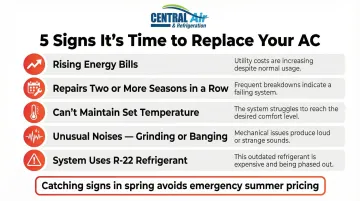
Timing matters: Discovering your AC needs replacing on a 100°F August day leaves you with few options and emergency pricing. Catching these signs in early spring gives you time to compare options, schedule on your terms, and avoid the summer rush.
How to Extend Your AC's Life in Bryan, TX
Texas AC systems run harder and longer than in most other states — often 2,000+ hours per year. That workload compounds wear fast, so the habits below matter more here than nearly anywhere else.
Essential Maintenance Habits
Change air filters monthly during peak cooling season. Dirty filters are the leading cause of evaporator coil freeze and blower motor strain — both expensive repairs that are almost entirely preventable.
Keep the outdoor condenser unit clear. Remove debris, grass, and leaves, maintain 2 feet of clearance around the unit, and trim vegetation regularly.
Flush the condensate drain line regularly. This prevents moisture backup, overflow, water damage, and mold growth — all common in Bryan's humid summers.
Annual Professional Tune-Up
A professional tune-up covers the failure points most likely to sideline your system mid-summer:
- Refrigerant charge check and leak inspection
- Static pressure measurement
- Capacitor and contactor testing (these fail frequently in Texas heat)
- Coil cleaning
Catching a $50 capacitor before it triggers a $1,200 compressor failure is the core ROI of preventive maintenance.
Central Air & Refrigeration's maintenance plans for Bryan homeowners include:
- Priority service and scheduling
- Discounts on repairs and replacement parts
- Detailed maintenance reports and recommendations
Home Envelope Improvements
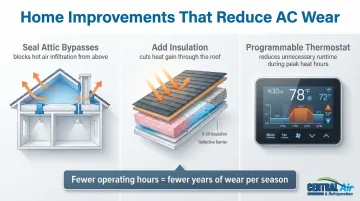
Reducing how hard your AC works is just as effective as maintaining the unit itself. Three upgrades make the biggest difference:
- Seal attic bypasses to block hot air infiltration from above
- Add insulation to cut heat gain through the roof
- Install a programmable thermostat to avoid unnecessary runtime during peak heat hours
Each of these reduces total operating hours — and fewer hours mean fewer years of wear per season.
Frequently Asked Questions
How long do AC units typically last in Texas?
Central AC units in Texas last 10–15 years, compared to the national average of 15–20 years. Bryan/Central Texas homeowners should plan for the lower end of that range (10–12 years) due to extended cooling seasons and extreme heat that forces systems to run 2,200+ hours annually.
How much does it cost to replace an AC unit in Texas?
Central AC replacement in Texas typically costs $6,000–$14,000 (equipment + installation). Size, SEER2 rating, and ductwork condition affect the final cost. Get multiple quotes and ask about financing options to make the investment more manageable.
Is it worth replacing an old AC unit in Texas?
It's worth replacing when repair costs are compounding, the unit is 13+ years old, or energy bills have risen significantly. Most modern systems reduce energy use by 20–40% compared to 15-year-old equipment, so lower monthly utility bills typically offset the upfront cost over time.
What is the $5000 rule for HVAC?
Multiply the repair cost by the system's age in years. If the result exceeds $5,000, replacement typically makes more financial sense than repair. Example: a 12-year-old unit needing a $600 repair (12 × $600 = $7,200) should be replaced. Use it as a starting point rather than a strict rule — your system's overall condition matters too.
What is the 3 minute rule for AC?
Wait at least 3 minutes after the system shuts off before restarting it, to allow refrigerant pressure to equalize and protect the compressor from a hard start. In Texas summers, when your system cycles frequently through long hot days, this habit can prevent premature compressor failure.
Ready to evaluate your AC system? Central Air & Refrigeration offers free, no-obligation assessments for Bryan homeowners. Call (979) 324-6791 to schedule a consultation and get expert guidance on whether repair or replacement is the right choice for your home.