Introduction
In Bryan, TX, summer temperatures regularly top 100°F from June through August — and once your AC stops, indoor temperatures can turn dangerous within hours. For elderly family members, young children, and anyone with a chronic health condition, a broken air conditioner in peak heat is a genuine safety emergency, not just a discomfort.
Most homeowners aren't sure where to start when their AC quits — check the thermostat, call a technician, or try a quick fix? This guide covers each step: immediate safety measures, simple diagnostic checks, when to call a professional, and how to decide between repair and replacement.
Key Takeaways
- Most Texas AC breakdowns trace back to overworked compressors, burned-out capacitors, refrigerant leaks, clogged filters, or dirty coils
- First response: Check thermostat settings, circuit breakers, and air filter before calling for service
- The 3-minute rule: Wait at least 3 minutes after any shutdown before restarting — skipping this can damage the compressor
- Systems 10+ years old with repeat failures are often cheaper to replace than to keep repairing
- Call a pro when: You encounter refrigerant issues, electrical faults, compressor failure, or anything beyond basic troubleshooting
Why AC Units Break Down During Texas Summers
Texas summers place AC systems under relentless, load that accelerates component wear. Unlike milder climates where systems cycle on and off throughout the day, Bryan homes often run AC 16–20 hours daily during peak months. This sustained operation pushes every component—compressor, capacitor, fan motor, and electrical connections—far beyond typical duty cycles, shortening equipment lifespan by 25–33% compared to national averages.
Compressor Overload
The compressor pressurizes refrigerant to transfer heat from inside your home to the outdoors. Non-stop Texas summer operation causes compressors to overheat, trip circuit breakers, or seize entirely.
Compressor failure is the single most expensive AC repair, often running $1,500–$3,000. On a system that's 10+ years old, replacement usually makes more financial sense than repair.
Capacitor Failure
Capacitors are small electrical components that provide the starting boost for your fan motor and compressor. High outdoor temperatures and constant cycling cause capacitors to burn out—the most common summer AC failure in Texas. Symptoms include the AC refusing to start, the outdoor fan not spinning despite the compressor humming, or the system clicking repeatedly without starting. Capacitor replacement typically costs $100–$400 and can be completed quickly by a certified technician.
Refrigerant Leaks
Refrigerant leaks that remain undetected during cooler months become obvious in summer when your system can't maintain temperature despite running constantly. Warning signs include:
- Ice forming on the indoor evaporator coil
- Warm air blowing from vents
- The unit running non-stop without cooling the home
- Hissing sounds near refrigerant lines
Refrigerant doesn't "run out" through normal use—if levels are low, you have a leak that a technician must repair before recharging. Adding refrigerant without fixing the leak wastes money and damages the environment.
Clogged Air Filter or Dirty Coils
A clogged air filter restricts airflow and causes the evaporator coil to freeze over, shutting down the entire system. According to the Department of Energy, dirty filters increase energy consumption by 5–15% and directly contribute to equipment failure. Similarly, dirty outdoor condenser coils trap heat and force the compressor to work harder until it overheats or fails. Both failures are completely preventable through regular maintenance.
Thermostat Malfunctions
A failing thermostat or dead thermostat batteries can mimic a complete AC breakdown. The unit may short-cycle (turn on and off rapidly), refuse to start, or run continuously without reaching the set temperature. Before assuming a major system failure, always check the thermostat first—it's the simplest and least expensive potential fix.
What to Do Immediately When Your AC Breaks Down – Step-by-Step
Following the right sequence prevents further system damage, protects household members from heat-related illness, and saves money by ruling out simple fixes before calling for service.
Step 1: Prioritize Safety and Reduce Indoor Heat
Immediately close blinds and curtains on sun-facing windows to block radiant heat gain. Move vulnerable household members—elderly, children, and pets—to the coolest room in the house or a neighbor's home if temperatures spike quickly.
Temporary cooling measures to buy time:
- Set up battery or plug-in fans to create airflow across your body
- Avoid using ovens or stoves (use microwave or prepare cold meals)
- Turn off incandescent lights and non-essential electronics that generate heat
- Apply cool, damp towels to neck, wrists, and forehead
- Stay hydrated with water (avoid alcohol and caffeine)
The CDC warns that when indoor temperatures climb into the high 90s, electric fans alone won't prevent heat-related illness—they can actually increase body temperature above 90°F.
Step 2: Check the Thermostat
Run through these quick checks before assuming a bigger problem:
- Confirm the mode is set to COOL (not FAN or HEAT)
- Set the target temperature at least 3–5 degrees below current room temperature
- Check that the display is illuminated — a dim or blank screen means dead batteries
- Make sure no one accidentally changed the system mode or settings
Step 3: Check the Circuit Breaker
AC units have two separate breakers—one for the indoor air handler/furnace and one for the outdoor condenser unit. Go to your electrical panel and look for any tripped breakers (they'll be in the middle position, not fully on or off). Reset once by switching fully off, then back on.
Warning: If the breaker trips again immediately after resetting, this signals a serious electrical fault—possibly a short circuit or failing component. Do not keep resetting the breaker. Call a professional immediately.
Step 4: Follow the 3-Minute Rule Before Restarting
After any shutdown or power interruption, wait at least 3 minutes before restarting your AC. This allows refrigerant pressure to equalize throughout the system and prevents the compressor from starting under excessive load, which can cause permanent damage. This rule is especially important after a breaker reset or power outage.
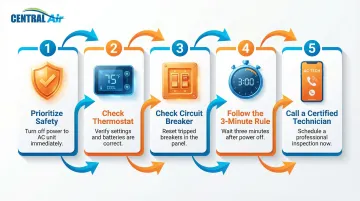
Step 5: Call a Certified HVAC Technician
If the above steps don't restore cooling within 15–20 minutes, the issue requires professional diagnosis. Attempting to open refrigerant lines, handle electrical components, or bypass safety switches without proper certification is dangerous and illegal under federal law.
Central Air & Refrigeration offers fast-response emergency service in Bryan, TX with 24/7 emergency service and transparent pricing. Call (979) 324-6791) for same-day emergency service — their certified technicians respond fast, even during peak Texas summer demand.
DIY Checks to Try Before the Tech Arrives
These checks are safe to run without tools or technical knowledge — and a few may restore cooling before the technician even arrives.
Check and Replace the Air Filter
Locate your air filter (usually in the return air vent or air handler cabinet), pull it out, and hold it up to light. If light doesn't pass through easily, replace it immediately with the correct size and MERV rating. ENERGY STAR recommends checking filters monthly during summer and replacing every 1–2 months, more frequently if you have pets.
A clogged filter restricts airflow and can cause the evaporator coil to freeze. If you spot ice on the indoor unit, shut the system off and let it thaw for 2–3 hours before restarting — running a frozen system causes further damage.
Inspect the Outdoor Condenser Unit
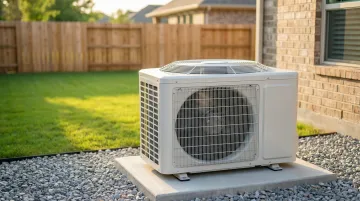
Go outside to the condenser unit and check whether the fan on top is spinning when the system is running. If the fan isn't spinning but you hear the compressor humming, this points to a failed capacitor, a quick and inexpensive repair typically costing $100–$400.
Also check that the unit isn't blocked by leaves, grass clippings, or debris, and that at least 2 feet of clearance exists on all sides. Manufacturers like Trane specify minimum clearances of 12 inches from walls and 5 feet above the unit for proper airflow.
Check the Condensate Drain Line
AC systems remove humidity and drain water through a condensate line. If this line clogs, a safety float switch shuts the system down to prevent water damage. Check for standing water in the drain pan under the air handler and locate the PVC drain line running to a floor drain or outside.
A clogged line can often be cleared by pouring a cup of diluted bleach down the access port or using a wet-vac on the drain outlet. If water still won't drain freely, schedule a professional clearing before restarting the system.
Note Any Sounds, Smells, or Symptoms to Report
Document exactly what the system is doing to help the technician diagnose the problem faster:
- Sounds: Clicking, buzzing, grinding, squealing, or banging noises
- Airflow: Warm air, weak airflow, or no air from vents
- Cooling pattern: One part of the house cooler than others
- Timing: When symptoms started and whether they're constant or intermittent
Should You Repair or Replace Your AC?
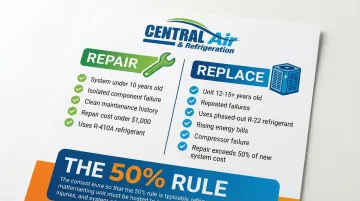
The repair-versus-replace decision comes down to three factors: system age, repair cost, and failure frequency. As a general guide: if a repair costs more than 50% of what a new system would cost, replacement usually wins — especially for units over 10 years old.
Repair Is the Right Call When...
- The system is under 10 years old
- The failure involves an isolated component (capacitor, contactor, drain line)
- The system has a clean maintenance history with few prior repairs
- The repair cost is under $1,000
- The unit uses modern R-410A refrigerant (not phased-out R-22)
A single repair on an otherwise healthy system is almost always worth the investment.
Replace Is the Right Call When...
Research shows that while AC units in milder climates last 15–20 years, Texas's extreme heat and near-constant summer runtime shortens that to 10–15 years—a 25-33% reduction in lifespan. Consider replacement when:
- The unit is 12–15+ years old
- The same component has failed repeatedly
- The system uses R-22 refrigerant (phased out by the EPA in 2020, with dwindling supplies and rising costs)
- Energy bills have been rising steadily despite similar usage
- The compressor has failed — on older units, compressor replacements typically cost $1,500–$3,000 and rarely make financial sense
- Total repair cost exceeds 50% of a new system's cost
Still unsure which way to go? Central Air & Refrigeration's technicians in Bryan, TX can assess your system on-site and give you a straight answer — no upselling, just honest advice and transparent pricing.
Preventive Maintenance Tips to Avoid Future Breakdowns
A single seasonal tune-up costs a fraction of an emergency repair. In Bryan's climate, skipping annual maintenance is a gamble that rarely pays off—the extreme heat accelerates wear on every component, and skipped maintenance shows up fast.
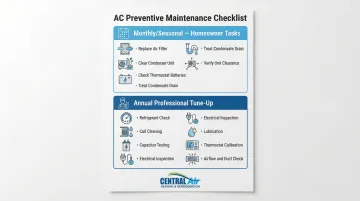
Monthly and Seasonal Actions Homeowners Can Take
During summer months:
- Replace air filters every 1–2 months (more frequently with pets)
- Keep the outdoor condenser unit clear of vegetation, leaves, and debris
- Check thermostat batteries each spring
- Pour diluted bleach down the condensate drain monthly to prevent algae clogs
- Verify at least 2 feet of clearance around the outdoor unit
Schedule a Professional Tune-Up Every Spring
A professional tune-up covers tasks that require specialized tools and certification:
- Checking refrigerant levels and testing for leaks
- Cleaning condenser and evaporator coils
- Testing capacitors and contactors
- Inspecting electrical connections and tightening terminals
- Lubricating moving parts to reduce friction
- Verifying thermostat calibration
- Checking airflow and duct integrity
HVAC industry research shows that planned maintenance reduces total maintenance costs by 50% and can extend equipment life by 5–10 years compared to neglected systems.
Schedule tune-ups in March or April — before Bryan's heat peaks — so your system is tested and ready when temperatures climb.
Central Air & Refrigeration offers pre-season tune-ups and maintenance plans for Bryan homeowners. Call (979) 324-6791 to book before the summer rush.
Know the Warning Signs Before a Full Breakdown
Act early when you notice these symptoms:
- Longer-than-normal cooling cycles
- Rising energy bills without usage changes
- Uneven cooling between rooms
- Weak airflow from vents
- Any unusual sounds (clicking, grinding, squealing)
Catching these signs early costs a fraction of an emergency call in 100°F heat.
Frequently Asked Questions
What is considered an AC emergency in Texas?
An AC emergency in Texas typically involves one or more of these conditions:
- Indoor temperatures above 90°F
- Household members who are elderly, very young, or have medical conditions
- Complete system failure during a heat advisory
Same-day service should be prioritized in any of these situations.
What is the 3-minute rule for air conditioners?
The 3-minute rule means waiting at least 3 minutes after an AC shuts off or loses power before restarting it. This allows refrigerant pressures to equalize and prevents the compressor from starting under excessive load, avoiding costly damage to the most expensive component in your system.
Why does my AC stop working in the summer?
Summer breakdowns are most commonly caused by overworked compressors, burned-out capacitors, refrigerant leaks, clogged filters, or dirty condenser coils—all worsened by the near-constant runtime Texas heat demands. Systems that run 16-20 hours daily experience accelerated wear on every component.
Is it normal for AC to struggle in 90 degree weather?
Most AC systems are designed to maintain indoor temperatures about 20°F below outdoor temps. In extreme heat above 95–100°F, some struggle is expected. An indoor reading of 78–80°F on a 100°F day means your system is working. If it falls more than a few degrees behind or runs continuously without cooling, schedule an inspection.
How much does an emergency HVAC call cost?
After-hours service calls typically run $150–$300 per hour, roughly 2-3 times the standard rate. Repair costs vary: capacitor replacement ($100–$400), refrigerant leak repair ($200–$1,500), compressor replacement ($600–$3,000). Always confirm upfront pricing before work begins.
How long do AC units last in Texas in summer?
While AC units in milder climates can last 15–20 years, the intense heat and near-constant summer runtime in Texas often shortens that to 10–15 years. Regular professional maintenance is the single biggest factor in maximizing system lifespan and preventing premature failure.