
Introduction
Picture this: it's another scorching 100°F afternoon in Bryan, your AC is humming steadily, yet your living room feels like an oven. If you're nodding along, you're experiencing one of the most frustrating—and common—HVAC complaints during Texas summers.
An air conditioner that runs without cooling is rarely a mystery. Most cases trace back to a handful of predictable causes — some you can fix yourself, others that need a licensed technician.
This guide covers the most likely culprits, what you can safely check yourself, and when it's time to call a pro.
Key Takeaways
- Most common causes: dirty air filter, wrong thermostat setting, low refrigerant, frozen coils, or a blocked outdoor unit
- DIY-friendly fixes include checking filters, thermostat settings, and clearing debris from the outdoor unit
- Refrigerant leaks, electrical failures, and compressor issues require a licensed HVAC technician
- Running a struggling AC too long worsens damage and drives up energy bills
- In extreme Texas heat, don't wait — call a certified local HVAC technician the same day
Why Texas Heat Makes AC Problems Worse
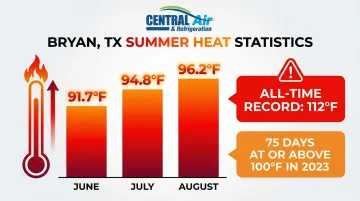
Bryan and the broader Brazos Valley region regularly see summer temperatures exceeding 100°F with high humidity, placing AC systems under far more stress than in milder climates. College Station/Bryan recorded 75 days at or above 100°F in 2023, shattering previous records. An AC that barely keeps up on a mild day can fail entirely when temperatures spike.
Texas summers are long—AC systems run nearly continuously for months, accelerating wear on components like capacitors, coils, and compressors. Average highs in Bryan tell the story:
- June: 91.7°F
- July: 94.8°F
- August: 96.2°F
- All-time record: 112°F
That's months of sustained heat — not occasional spikes — and your equipment pays the price.
Understanding the 20°F Cooling Limit
Most residential AC systems are rated to cool a home to about 20°F below the outdoor design temperature. On a 105°F day, expecting your system to reach 72°F indoors is pushing the limits of most residential units—something Texas homeowners need to understand when diagnosing a "not cooling" complaint.
This design limitation doesn't mean your AC is broken. It means the system is operating at the edge of its capacity. That said, if your home can't reach even 85°F when it's 105°F outside, something beyond normal capacity strain is at play — a refrigerant leak, a failing compressor, or blocked airflow are the most likely culprits worth investigating.
Common Reasons Your AC Is Running But Not Cooling
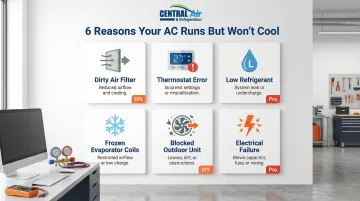
Most AC cooling failures trace back to one of a handful of predictable root causes. Knowing which one you're dealing with determines the right fix.
Dirty or Clogged Air Filter
A heavily loaded filter restricts airflow, starving the system of the air it needs to transfer heat. The AC runs but can't cool effectively.
In Texas, where systems run almost year-round, filters clog faster than the recommended 30–90 day replacement cycle. During peak summer months, check your filter every 30 days and replace it if you can't see light through it when held up to a lamp.
Signs of a clogged filter:
- Weak airflow from vents
- System runs constantly without reaching setpoint
- Ice forming on indoor unit
- Higher energy bills
Thermostat Set Incorrectly or Malfunctioning
Two common errors cause this problem:
Fan set to "ON" instead of "AUTO": This setting blows air continuously, even when the AC isn't actively cooling. You'll feel air movement, but it won't be cold.
Setpoint beyond system capacity: On a 105°F Texas day, setting your thermostat to 68°F is often unrealistic. The system runs constantly trying to hit a target it can't reach.
A failing or miscalibrated thermostat may not trigger the cooling cycle at all, leaving you with a fan that runs but no actual cooling.
Low Refrigerant or Refrigerant Leak
Refrigerant is the substance that absorbs heat from indoor air. When levels drop due to a leak, cooling capacity drops with it.
Symptoms include:
- Warm air from vents
- Ice forming on the indoor coil or refrigerant lines
- System running constantly without cooling
- Hissing or bubbling sounds near the unit
Important: This is not a DIY fix. Handling refrigerant requires EPA Section 608 certification. It's illegal for uncertified individuals to purchase or handle refrigerant. A certified technician must locate the leak, repair it, and recharge the system to the manufacturer's specified levels.
Frozen Evaporator Coils
Restricted airflow from a dirty filter, blocked vents, or low refrigerant causes the evaporator coil to ice over. A frozen coil cannot absorb heat, so the AC blows warm air—or no air at all.
Turning the system off to thaw the coil is the first step, but the underlying cause must still be addressed. If the coil freezes again after thawing, you have a refrigerant leak or airflow problem that requires professional diagnosis.
Dirty or Blocked Outdoor Condenser Unit
The outdoor unit releases heat pulled from inside your home. If it's packed with debris, leaves, or grass clippings—common in Texas yards—it can't expel heat efficiently.
What happens:
- System overheats and shuts down
- Reduced cooling capacity
- Compressor strain and premature failure
A failing condenser fan motor or bad capacitor can cause the same problem. Capacitors in Texas heat often fail in 2-3 years rather than their rated 5-10 year lifespan.
Electrical Issues
If a start capacitor fails, the compressor or fan motor won't kick on even though the system appears to be running. A tripped breaker can power the indoor air handler but leave the outdoor unit off entirely.
Common electrical failures:
- Failed capacitors (most common in Texas heat)
- Worn contactors
- Tripped circuit breakers
- Faulty wiring connections
On aging Texas systems running under heavy seasonal load, electrical components wear out faster than rated specs suggest. Central Air & Refrigeration diagnoses these failures before they cascade into compressor or motor replacements—which cost significantly more.
How to Troubleshoot: What to Check Yourself vs. When to Call a Pro
Work through these steps in order — starting with the simplest checks before escalating to anything that requires a technician.
Step 1: Check the Thermostat First
- Confirm it's set to "Cool" mode (not "Fan Only")
- Verify the temperature setpoint is at least 3–5°F below current room temperature
- Check that the fan is set to "Auto" not "On"
- Replace batteries if the display seems unresponsive
Wait 5 minutes after adjusting settings before concluding there's no change—most systems have a built-in delay to protect the compressor.
Step 2: Inspect the Air Filter and Vents
- Locate the return air filter (usually near the air handler or a large return vent)
- Pull it out and hold it up to light — if you can't see through it, replace it immediately
- Walk through your home and confirm all supply vents are open
- Check that no furniture or rugs are blocking airflow to the vents
Step 3: Check the Outdoor Unit
Safety first: Only perform visual inspections. Do not open panels or touch electrical components.
- Confirm the outdoor unit is running (fan spinning, compressor humming)
- Clear away debris or vegetation within 2 feet of the unit
- Gently rinse dirty fins with a garden hose from the inside out
If the unit is not running at all while the indoor unit is on, or if you hear grinding or buzzing, stop and call a professional. Do not attempt to access internal components.
Step 4: Look for Ice on the Indoor Unit
If accessible, check the indoor air handler for visible frost or ice around the coil or refrigerant lines.
If ice is present:
- Turn the system completely off (not just to "Fan")
- Let it thaw for 2–3 hours
- After thawing, restart and monitor
If it freezes again, the root cause—low refrigerant or restricted airflow—needs professional diagnosis.
Step 5: Know When to Stop and Call a Pro
Call Central Air & Refrigeration at (979) 324-6791 if:
- The filter is clean, thermostat is correct, outdoor unit looks clear, but it's still not cooling
- You notice warm air from vents
- You hear hissing sounds (refrigerant leak)
- Ice buildup returns after thawing
- A breaker keeps tripping
- The outdoor unit won't run at all
These are signs of refrigerant leaks, electrical faults, or compressor failure — all requiring a certified technician. Central Air & Refrigeration provides 24/7 emergency service to Bryan, TX homeowners and businesses.
Should You Repair or Replace Your AC?
The repair vs. replace decision comes down to cost, risk, and long-term performance. The age of your system and the nature of the failure are the two most important factors.
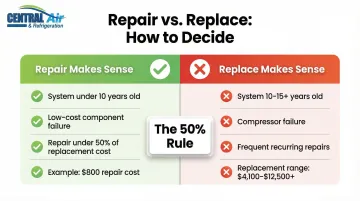
When Repair Makes Sense
Consider repair when:
- The system is under 10 years old
- The failed component (capacitor, contactor, dirty coils) is relatively inexpensive to fix
- Repair cost does not exceed roughly 50% of what a new system would cost
Capacitor replacements and refrigerant recharges after a small leak are common examples — usually a few hundred dollars versus several thousand for a new unit.
When Replacement Makes More Sense
Consider replacement when:
- The system is 10–15+ years old
- The compressor has failed (one of the most expensive components)
- The system requires frequent repairs adding up to significant cost
- It's undersized for your home and has always struggled in Texas heat
New residential AC installations in Texas typically range from $4,100 to $8,700 for standard replacements, with high-efficiency systems reaching $12,500+.
The 50% Rule
If repair costs exceed 50% of replacement cost, replacement usually makes better financial sense. For example, if a new system costs $6,000 and the repair quote is $3,500, replacement is the smarter long-term investment.
If you're unsure which direction makes sense, Central Air & Refrigeration can walk you through the numbers — repair vs. replace — based on your specific system and Bryan's climate demands.
How to Prevent Your AC From Struggling in Texas Heat
In a climate like Bryan, where systems run almost continuously for 6+ months, preventive maintenance is essential for lower repair costs and longer system life.
Key Preventive Actions
- Replace your filter every 30 days during peak season — not every 90. Texas summer heat loads filters faster than the label suggests.
- Keep at least 2 feet of clearance around the outdoor condenser. Trim vegetation regularly and clear debris after storms.
- Flush condensate drain lines once a year. Clogs trigger safety shutoffs that kill cooling entirely.
Schedule Professional Maintenance
Annual maintenance can improve system efficiency by up to 15% while catching early warning signs before they become expensive failures.
Schedule a professional tune-up once a year, ideally in spring before the Texas heat season begins. A certified technician will:
- Check refrigerant levels
- Clean coils
- Test electrical components and tighten connections
- Inspect condensate drains
- Lubricate moving parts
Central Air & Refrigeration serves Bryan, TX homeowners with annual maintenance visits designed to keep systems running efficiently through the long Texas summer — before a small issue becomes a breakdown in 100-degree heat.
Conclusion
Most AC cooling failures in Texas follow predictable patterns: dirty filters, thermostat errors, refrigerant issues, frozen coils, or electrical faults. Many can be identified quickly with a structured check, but some require professional diagnosis to fix safely and permanently.
If you've worked through the basic checks and your AC is still running without cooling, stop waiting — a struggling system in 100°F+ Texas heat can cause expensive secondary damage to the compressor and other components.
Contact Central Air & Refrigeration at (979) 324-6791 for fast diagnosis and repair. With 10+ years serving Bryan, TX, 24/7 emergency availability, and certified HVAC technicians, you'll have a cool home again quickly — with transparent pricing and no surprises.
Frequently Asked Questions
Why is my AC running but not cooling?
The most common causes are a dirty air filter restricting airflow, incorrect thermostat settings (fan set to "ON" instead of "AUTO"), low refrigerant from a leak, frozen evaporator coils, or a blocked outdoor condenser unit. Start with the simplest checks—filter and thermostat—before moving to more complex diagnostics.
Should I turn off the AC if it's not cooling?
Yes—turn it off or switch to fan-only mode rather than keep running it, especially if coils are frozen or the compressor is straining. Running a malfunctioning system longer than necessary drives up repair costs and risks further damage.
Why is my AC set to 74 but reads 78?
On extremely hot Texas days (100°F+), your AC may be working correctly but simply unable to overcome the heat load fast enough due to the 20°F design limitation. Other possible causes include a miscalibrated or poorly placed thermostat, dirty filter restricting airflow, or an undersized system for your home.
What is the 3 minute rule for air conditioners?
The 3-minute rule refers to waiting at least 3 minutes after turning off or adjusting an AC before restarting it. This protects the compressor from pressure-related damage caused by rapid cycling. Most modern thermostats enforce this delay automatically.
How long should it take to cool a house from 90 to 72?
A properly sized AC cools at roughly 1–2°F per hour in extreme heat, so dropping from 90°F to 72°F can take several hours on a brutal Texas day. If it's taking far longer than that, the system likely needs a professional diagnosis.
How much does it typically cost to fix an AC that's not cooling?
Repair costs vary widely based on the cause. A capacitor replacement might cost $150–$400, while refrigerant leak repair ranges from $500–$1,500, and compressor replacement can exceed $2,000. Always get an upfront quote before authorizing any work. Central Air & Refrigeration offers free estimates with no hidden fees—call (979) 324-6791 to schedule a diagnostic.